Introduction
The phrase “Midjourney API” has become one of the most searched developer queries in AI image generation. Yet most users quickly discover a frustrating reality: Midjourney still does not offer a traditional public API in the same way as platforms like Open AI or Stability AI.
That creates a major challenge for developers, SaaS founders, automation engineers, and AI startups that want to integrate Midjourney-quality visuals into apps, workflows, or scalable products.
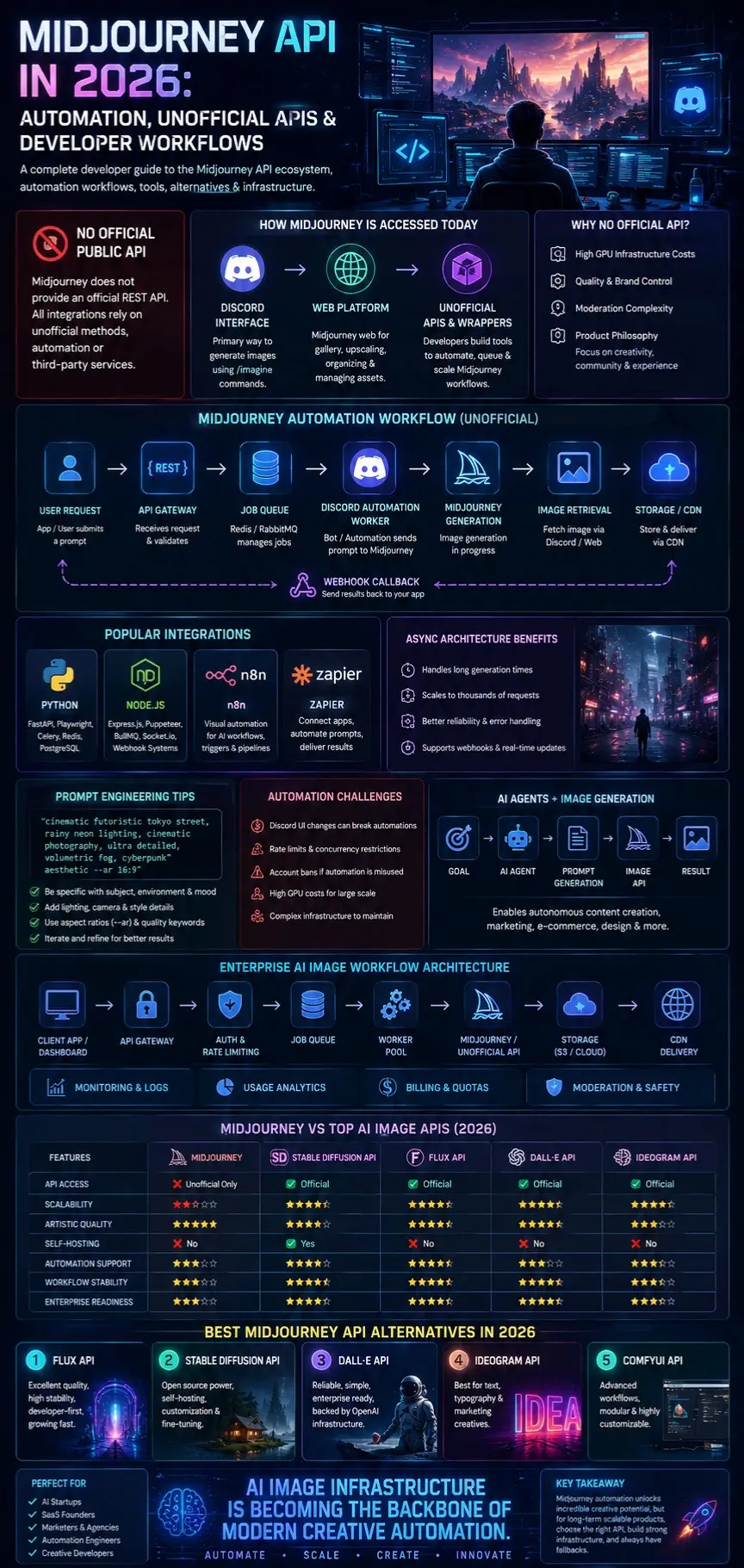
Instead of a normal REST API, Midjourney primarily operates through Discord and its web platform. Because of that, an entire ecosystem of unofficial APIs, automation wrappers, queue systems, and proxy services has emerged in 2026.
Some solutions work surprisingly well. Others come with serious risks, including account bans, reliability issues, and scalability limitations.
This guide explains how the Midjourney API ecosystem actually works today — including automation methods, async workflows, architecture strategies, pricing considerations, legal concerns, prompt engineering systems, and the best alternatives for production-grade AI image generation.
If you are building AI products, automation pipelines, or creative SaaS applications, this is the practical developer-focused guide most competitor articles completely miss.
What Is the Midjourney API?
The term Midjourney API usually refers to one of three things:
- An unofficial automation layer connected to Discord
- A wrapper around Midjourney commands
- A third-party REST API service that automates Midjourney generation
Unlike traditional AI APIs, Midjourney was originally designed around Discord interaction rather than developer infrastructure.
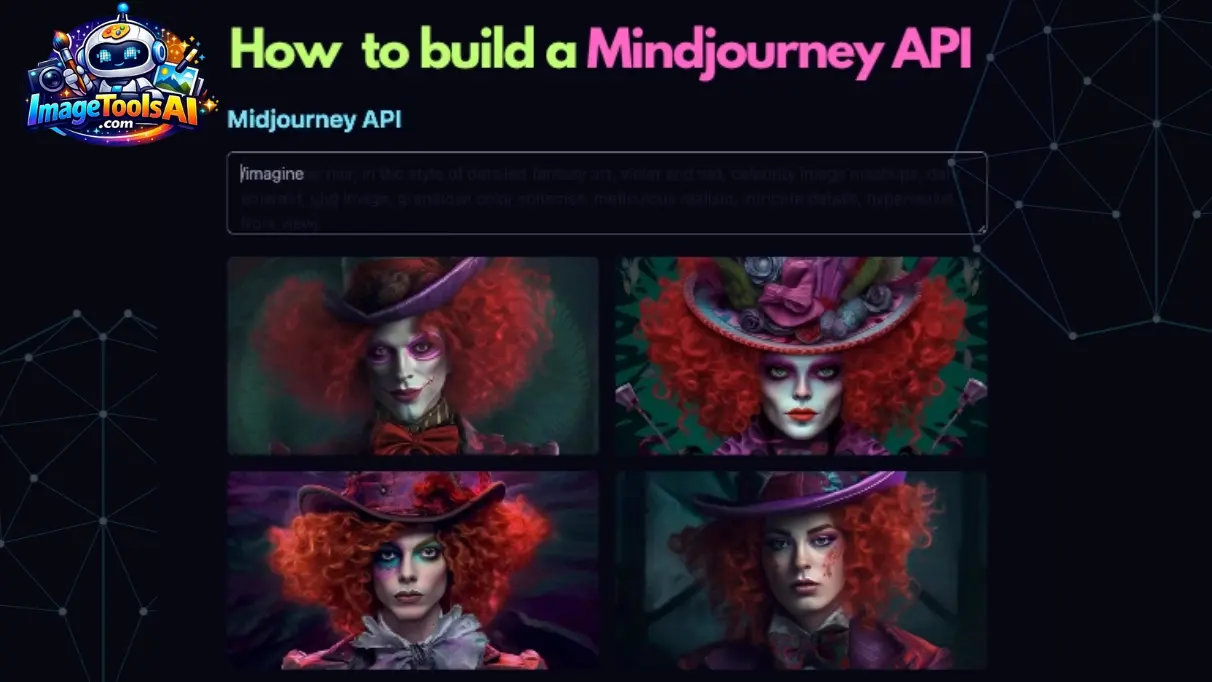
Users typically generate images by typing commands such as:
/imagine futuristic cyberpunk city at sunset
inside Discord channels.
Because of this design, developers created tools that simulate or automate these interactions.
That is why the “Midjourney API ecosystem” in 2026 is fragmented compared to mature AI APIs.
Does Midjourney Have an Official API?
No — Midjourney still does not provide a fully public official API for developers.
However, the situation is more nuanced than most articles suggest.
Midjourney has gradually expanded its web platform and developer ecosystem discussions, but there is still no officially documented REST API comparable to:
- OpenAI APIs
- Google AI services
- Stability AI endpoints
- Flux API providers
This gap created massive demand for unofficial solutions.
Why Midjourney Still Has No Public API
Several factors likely explain why Midjourney avoids public API access.
GPU Infrastructure Costs
Midjourney rendering is extremely GPU-intensive.
Opening unrestricted API access could dramatically increase infrastructure costs and abuse risk.
Brand Quality Control
Midjourney focuses heavily on artistic quality and user experience.
A public API could create:
- Spam applications
- Low-quality outputs
- Abuse at scale
- Brand dilution
Moderation Complexity
AI image moderation is difficult at enterprise scale.
Discord-based workflows provide more centralized moderation controls.
Product Philosophy
Midjourney historically prioritized:
- Creative communities
- Interactive workflows
- Artistic experimentation
rather than developer-first infrastructure.
How Unofficial Midjourney APIs Work
Unofficial Midjourney APIs usually operate using one of these methods:
| Method | How It Works | Risk Level |
| Discord Automation | Simulates Discord commands | High |
| Browser Automation | Automates web interactions | Medium-High |
| Proxy API Services | Third-party wrapper APIs | Medium |
| Bot Automation | Uses custom Discord bots | High |
| Hybrid Systems | Queue + webhook orchestration | Medium |
Midjourney Discord Automation Explained
Discord automation is the backbone of most unofficial Midjourney APIs.
Developers often use:
- Headless browsers
- Discord bots
- Selenium automation
- Playwright automation
- WebSocket listeners
to automate command submission and image retrieval.
Common Workflow
User Request → Queue System → Discord Automation → Midjourney Generation → Image Retrieval → CDN Delivery
The challenge is reliability.
Discord interfaces can change unexpectedly, breaking automation systems overnight.
Midjourney API Workflow Diagram
Frontend App
↓
REST API Gateway
↓
Job Queue (Redis/RabbitMQ)
↓
Discord Automation Worker
↓
Midjourney Generation
↓
Image Retrieval Service
↓
Cloud Storage/CDN
↓
Webhook Callback to App
This architecture is far more complex than most simple API tutorials explain.
How Developers Automate Midjourney
Common Automation Stacks
Python Stack
- FastAPI
- Playwright
- Redis
- Celery
- PostgreSQL
Node.js Stack
- Express.js
- Puppeteer
- BullMQ
- Socket.io
No-Code Stack
- n8n
- Zapier
- Make.com
Midjourney API Python Tutorial
Here is a simplified example using Python requests for a wrapper API.
import requests
url = “https://example-api.com/generate”
payload = {
“prompt”: “cinematic futuristic city skyline”,
“aspect_ratio”: “16:9”
}
headers = {
“Authorization”: “Bearer YOUR_API_KEY”
}
response = requests.post(url, json=payload, headers=headers)
print(response.json())
Production Improvements
Real systems should include:
- Retry logic
- Async processing
- Webhook callbacks
- Queue monitoring
- Rate limiting
- Logging
Midjourney API Node.js Tutorial
const axios = require(“axios”);
async function generateImage() {
const response = await axios.post(
“https://example-api.com/generate”,
{
prompt: “ultra realistic sci-fi warrior”,
},
{
headers: {
Authorization: “Bearer YOUR_API_KEY”,
},
}
);
console.log(response.data);
}
generateImage();
Node.js is commonly used for:
- SaaS integrations
- AI automation dashboards
- real-time generation apps
- async webhook systems
Midjourney API with n8n
n8n became one of the biggest automation platforms for AI workflows.
Popular n8n Use Cases
- Auto-generate blog thumbnails
- Social media image automation
- E-commerce product visuals
- AI marketing pipelines
- AI agents with image output
Example Workflow
Webhook Trigger → Prompt Formatter → Midjourney API → Image Storage → Slack Notification
n8n is especially popular because it allows visual automation without heavy coding.
Midjourney API with Zapier
Zapier workflows are typically simpler than n8n setups.
Common Zapier Automations
- Generate Pinterest graphics
- Create blog featured images
- AI marketing assets
- Auto-create ad creatives
However, Zapier may become expensive at high image volumes.
Midjourney API Prompt Engineering
Prompt engineering is one of the biggest quality differentiators.
Strong Prompt Structure
Subject + Environment + Lighting + Camera Style + Artistic Style + Detail Level
Example
futuristic Tokyo street, rainy neon lighting, cinematic photography, ultra detailed, volumetric fog, cyberpunk aesthetic
High-Converting Prompt Tips
- Use lighting descriptions
- Add camera terminology
- Specify mood and atmosphere
- Include aspect ratios
- Use stylistic references carefully
Midjourney API Pricing & Costs
Pricing is difficult because there is no standard official API model.
Common Cost Factors
| Factor | Impact |
| GPU usage | High |
| Concurrent jobs | High |
| Queue wait times | Medium |
| Upscaling | Medium |
| Fast mode usage | High |
| Third-party wrappers | Medium |
Realistic Cost Considerations
Small projects may cost very little.
But large SaaS systems can face:
- GPU scaling costs
- proxy infrastructure fees
- webhook hosting costs
- queue management expenses
Midjourney API vs Stable Diffusion API
| Feature | Midjourney | Stable Diffusion |
| Official API | No | Yes |
| Self-hosting | No | Yes |
| Artistic Quality | Excellent | Variable |
| Developer Flexibility | Limited | Very High |
| Scalability | Difficult | Easier |
| Fine-Tuning | Limited | Excellent |
| Enterprise Readiness | Medium | High |
Stability AI systems are often preferred for enterprise deployments because developers can fully control the infrastructure.
Midjourney API vs Flux API
Flux rapidly became a major competitor in 2026.
| Feature | Midjourney | Flux |
| API Access | Unofficial | Strong |
| Workflow Stability | Medium | High |
| Developer Ecosystem | Medium | Growing Fast |
| Photorealism | Excellent | Excellent |
| Infrastructure Flexibility | Low | High |
| Automation Support | Limited | Strong |
Flux is increasingly attractive for startups needing scalable AI image infrastructure.
Best Midjourney API Alternatives
Flux API
Excellent for:
- scalable SaaS products
- enterprise workflows
- stable automation
Stable Diffusion API
Best for:
- self-hosting
- customization
- fine-tuning
DALL·E APIs
Strong for:
- reliability
- structured developer tooling
- enterprise integrations
Ideogram
Great for:
- typography generation
- marketing graphics
ComfyUI APIs
Popular for advanced workflows and modular image pipelines.
Midjourney API for AI Agents
AI agents increasingly generate images autonomously.
Example Agent Workflow
User Goal → AI Agent → Prompt Generation → Image API → Storage → Delivery
This enables:
- autonomous marketing systems
- AI content creators
- automated ecommerce pipelines
Enterprise AI Image Generation Workflows
Large-scale AI image systems require far more than simple prompt submission.
Enterprise Architecture Often Includes
- API gateways
- orchestration layers
- moderation systems
- image storage pipelines
- CDN delivery
- analytics dashboards
- billing systems
- usage tracking
This is why enterprises often prefer official APIs with SLAs and infrastructure guarantees.
Benefits for Creators & Businesses
Creators
- Faster content production
- automated social graphics
- scalable visual workflows
Agencies
- mass campaign generation
- ad creative testing
- AI marketing automation
SaaS Founders
- AI-powered design tools
- scalable visual generation
- content automation systems
Pros & Cons of Midjourney API Automation
| Pros | Cons |
| Incredible image quality | No official API |
| Strong artistic outputs | Automation risks |
| Excellent visual consistency | Scaling complexity |
| Popular creator ecosystem | Discord dependency |
| Huge community | Reliability issues |
Common Mistakes Developers Make
Ignoring Async Design
Image generation is not instant.
No Queue System
This causes overload quickly.
Weak Retry Logic
Failures happen frequently.
Poor Prompt Structuring
Bad prompts waste GPU resources.
Over-Reliance on One Provider
Always build fallback systems.
Best Prompt Templates for Midjourney APIs
Cinematic Prompt
cinematic futuristic skyline, golden hour lighting, volumetric fog, ultra realistic, shot on Sony A7R IV
Product Photography Prompt
luxury smartwatch on reflective black surface, studio lighting, hyper realistic commercial photography
Fantasy Art Prompt
ancient dragon flying above snowy mountains, epic fantasy art, dramatic lighting, ultra detailed
Privacy, Safety & Commercial Use
Developers should carefully evaluate:
- Commercial Rights
- image ownership
- moderation policies
- user privacy
- storage compliance
Especially when building SaaS products for clients.
Always verify official terms before production deployment.
Future of the Midjourney API
Several trends are shaping the future:
Increasing Demand for Official APIs
Developer demand keeps growing.
AI Agent Infrastructure
AI agents need image APIs.
Workflow Automation Expansion
Visual automation is becoming mainstream.
Enterprise AI Pipelines
Companies increasingly integrate AI image generation into operations.
Hybrid AI Systems
Many businesses now combine:
- Midjourney
- Flux
- SDXL
- DALL·E
inside unified workflows.
Who Should Use Midjourney API Automation?
Best For
- AI startups
- creative SaaS founders
- marketers
- automation engineers
- experimental AI projects
Less Ideal For
- highly regulated enterprises
- mission-critical systems
- apps requiring guaranteed uptime
- businesses needing official support
People Also Ask
A: No. Midjourney still does not provide a fully public developer API in 2026. Most integrations rely on unofficial automation systems or third-party wrappers.
A: Yes. Automation may create reliability issues or account risks depending on implementation methods and usage scale.
A: Flux and Stable Diffusion APIs are among the strongest alternatives because they offer more scalable developer infrastructure.
A: Yes. Developers commonly use Python with wrapper APIs, Discord automation tools, async queues, and webhook systems.
A: It can work for prototypes or niche products, but enterprises often prefer APIs with official support and infrastructure guarantees.
Conclusion
The keyword “Midjourney API” represents one of the most important AI developer search opportunities in 2026 because the ecosystem remains fragmented, misunderstood, and underserved.
Most articles stop after saying “Midjourney has no API.”
But the real story is much larger.
Developers today are building sophisticated automation systems around Midjourney using unofficial wrappers, Discord Automation, web hook pipelines, and scalable AI infrastructure strategies.
For creators and startups, these workflows can unlock powerful AI image generation capabilities.
For enterprises, however, stability, compliance, and scalability remain major concerns — which is why alternatives like Flux and Stable Diffusion continue gaining momentum.
If you are building AI products, automation systems, or image-generation workflows, understanding these architectural tradeoffs is essential before deploying production infrastructure.
For more AI image technology research, developer tutorials, automation workflows, and AI tool comparisons, explore additional guides on ImageToolsAI.com.