Introduction:
Out of nowhere, machines started drawing pictures just like people describe them. One moment, someone types words. This shift didn’t come slowly; it jumped forward fast when OpenAI built something called DALL·E 3. Instead of needing design skills, users now feed sentences into a system. From those lines, visuals form instantly. Behind the scenes, artificial intelligence redefines who gets to make art. Not every tool changes things so deeply. Yet here we are – writing shapes images, imagination links directly to output, all because code learned how language looks.
Picture this: DALL·E 3 links what people dream up with what machines can create. Gone are the days of needing years of art school, knowing how to use Photoshop, or mastering design tools. Just explain your thought using everyday words – then watch it become an image. The model takes those sentences, then builds pictures straight from them.
By 2026, the system had shifted – now shaped by advanced natural language processing that grasps subtle meanings, links ideas across context, while catching tone on purpose. Though built differently than before, it tracks intention more fluidly, responding not just to words but how they sit together, making exchanges feel less like queries, more like thought following thought.
Key Advancements in 2026 Include:
- Improved semantic understanding of long prompts
- Enhanced image realism and texture fidelity
- Better spatial awareness and object consistency
- Strong integration with conversational AI systems like ChatGPT
- Safer and more controlled content generation
Folks in marketing find it useful, while brands rely on it just as much. Advertising leans into its visuals, whereas classrooms make space for it too. Freelancers use the tool often; online stores tap into it regularly.
This piece builds from the ground up, starting simple, then moving into sharper techniques for shaping prompts. One idea follows another, each stepping forward without rushing ahead too soon.
What is DALL·E 3?
A picture-making machine built on advanced networks reads plain words, turning them into images through smart language understanding. This version learns from huge amounts of text and art, linking phrases to shapes using pattern-heavy training. Instead of copying, it imagines scenes by connecting ideas like colors, objects, and actions described in sentences. Understanding context matters – small changes in wording shift how elements appear together.
Simplified Definition:
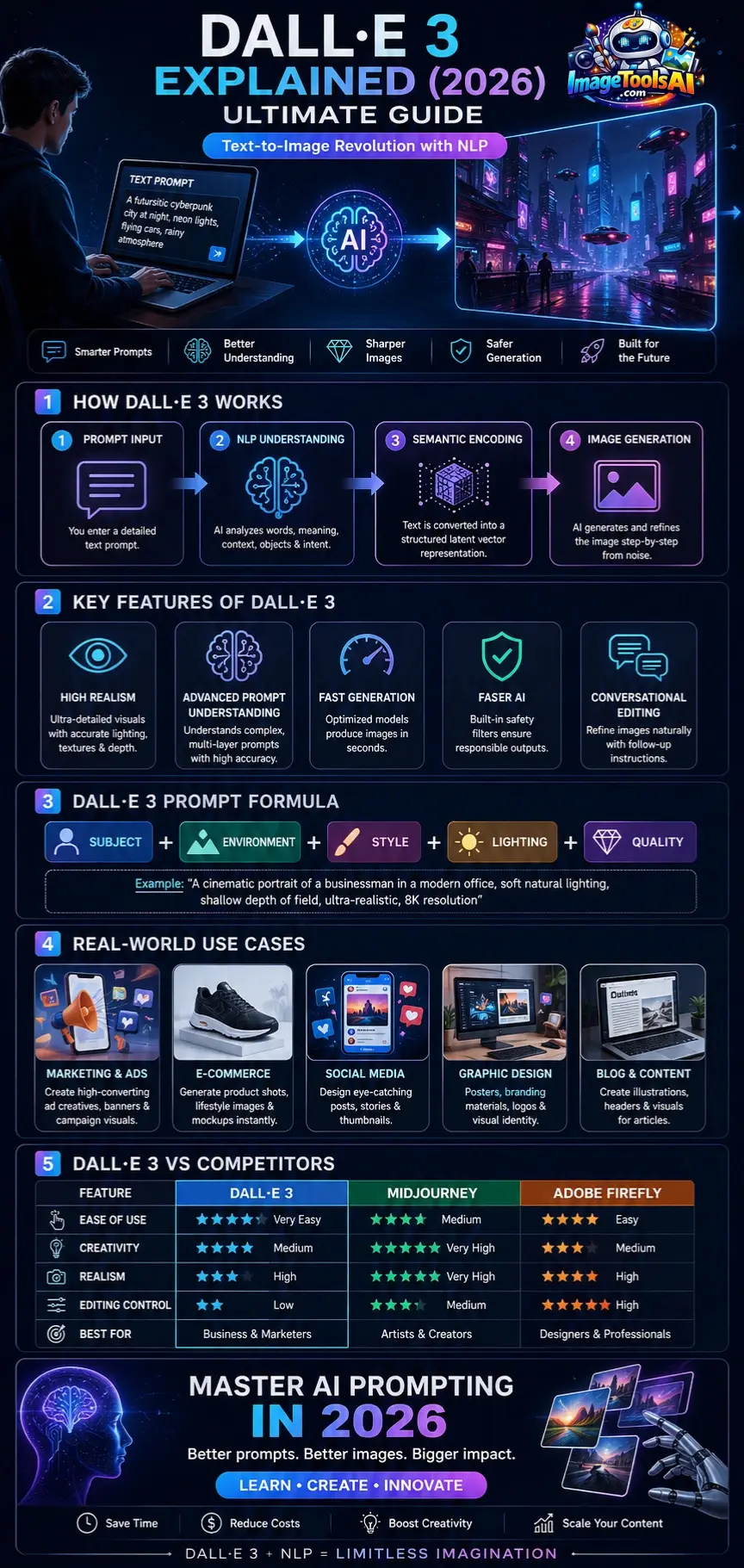
You input a sentence → AI interprets meaning → AI generates an image.
Example:
Prompt:
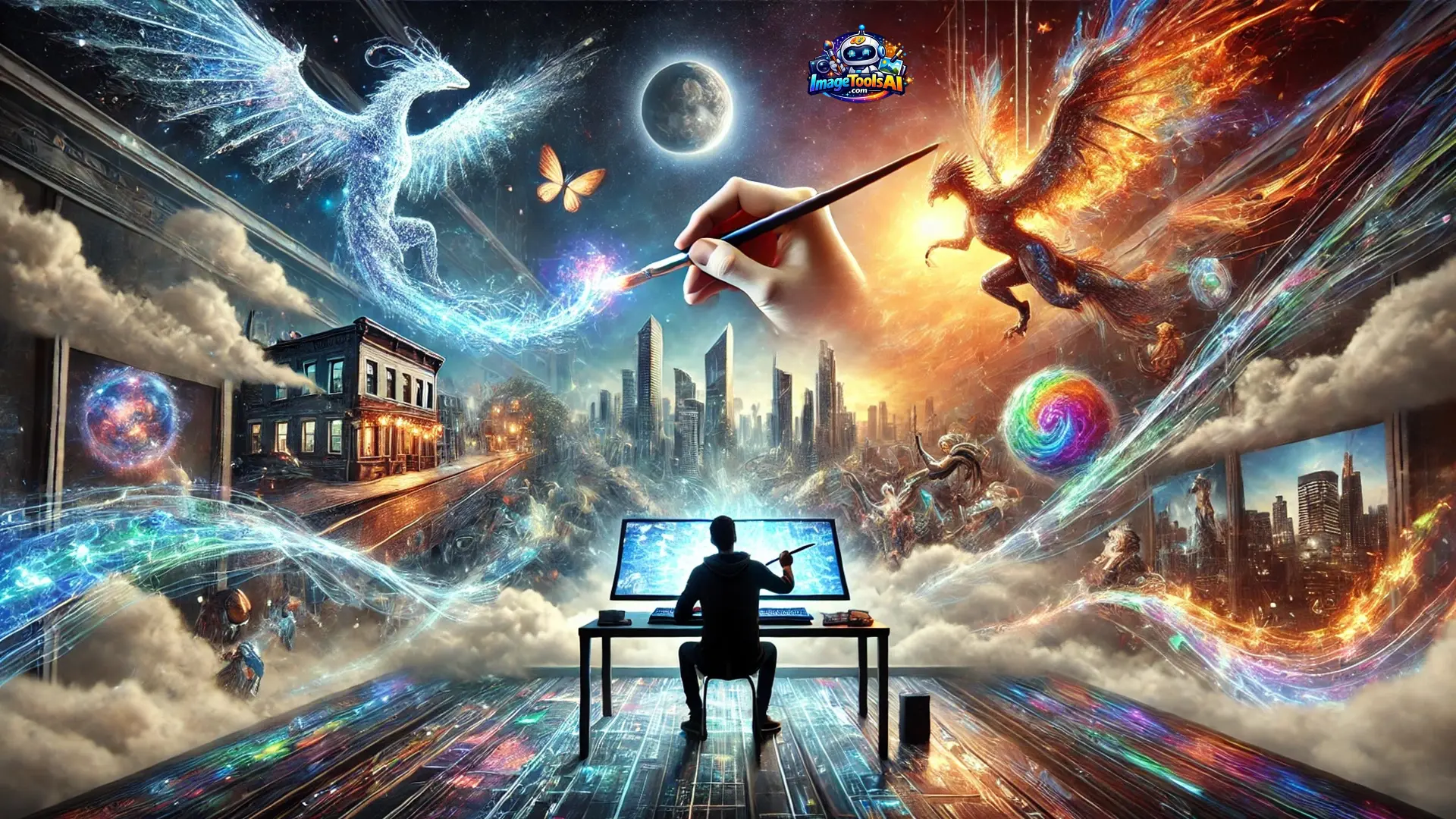
“A futuristic cyberpunk skyline with flying vehicles, neon reflections, and rainy atmosphere at night”
Output:
A high-resolution, AI-generated cinematic image reflecting the described environment.
Why DALL·E 3 is Technologically Different
Unlike earlier generative models, DALL·E 3 does not rely solely on keyword matching. Instead, it leverages semantic understanding, meaning it interprets intent, relationships, and context.
Key NLP Improvements:
- Context-aware language interpretation
- Multi-object spatial reasoning
- Semantic consistency across elements
- Improved prompt decomposition
This makes outputs more accurate, coherent, and visually aligned with user expectations.
How DALL·E 3 Works
DALL·E 3 operates through a multi-stage generative pipeline combining NLP and diffusion-based image modeling.
Natural Language Understanding
The system processes the input prompt using transformer-based NLP models. It identifies:
- Attributes (color, shape, style)
- Context (environment or background)
- Intent (artistic, realistic, cinematic, etc.)
Semantic Encoding
The prompt is converted into a structured latent representation, where meaning is mapped into a vector space.
Image Synthesis
The model gradually generates an image from noise by refining details step-by-step.
Output Optimization
- Sharpness
- Lighting Balance
- Composition alignment
- Object correctness
Workflow Overview
| Stage | Function |
| Input | User writes prompt |
| NLP Processing | AI interprets meaning |
| Encoding | Converts text into vectors |
| Generation | Builds image progressively |
| Refinement | Enhances final output |
Key Features of DALL·E 3
Advanced Prompt Understanding
DALL·E 3 can interpret complex sentence structures, multi-layer instructions, and stylistic commands.
High-Fidelity Image Output
Produces ultra-detailed visuals with improved realism, lighting accuracy, and texture depth.
Contextual Awareness
Objects within the image maintain logical relationships, reducing common AI mistakes like distorted anatomy or misplaced objects.
Fast Generative Performance
Optimized inference systems allow image generation within seconds.
Safety & Content Filtering
Built-in moderation systems ensure safe outputs by filtering inappropriate content.
Conversational Prompt Refinement
Users can iteratively refine images using natural language:
- “Make it more cinematic.”
- “Add golden hour lighting.”
- “Change background to futuristic city”
How to Use DALL·E 3
Access Platform
Use ChatGPT or OpenAI-supported tools that integrate image generation.
Write Structured Prompt
Example:
“A luxury wristwatch placed on black marble with soft studio lighting and shallow depth of field”
Enhance with NLP Keywords
Improve results using:
- Lighting terms
- Camera angles
- Emotional tone
- Artistic Styles
Generate Image
Submit prompt and allow AI processing.
Iterate & Optimize
Refine output using follow-up instructions.
Best DALL·E 3 Prompt Formula
Formula Structure:
Subject + Environment + Style + Lighting + Quality Descriptor
Example:
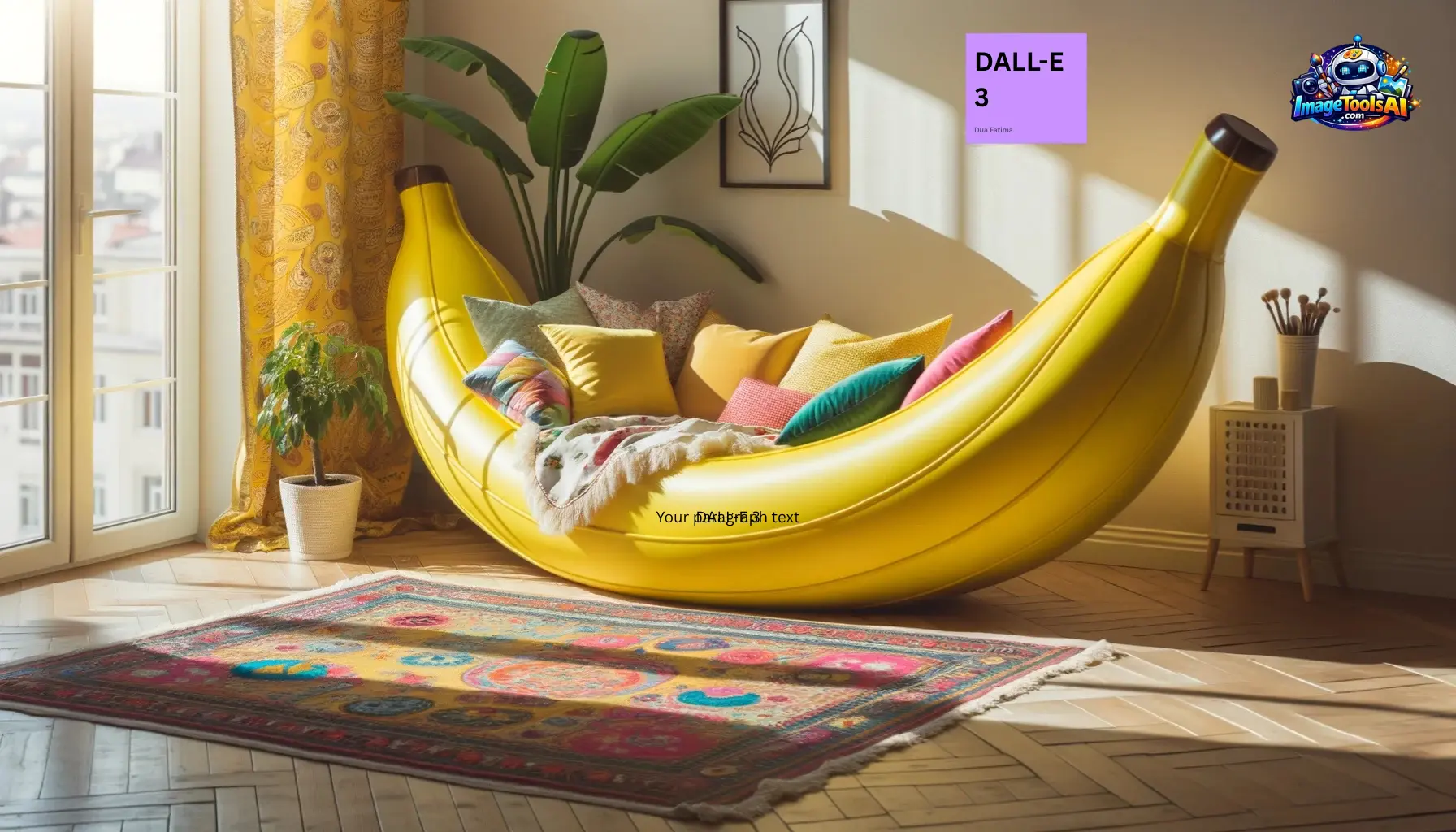
“A cinematic portrait of a businessman in a modern office environment, soft natural lighting, shallow depth of field, ultra-realistic rendering, 8K resolution”
Advanced Prompt Engineering Techniques
Use Semantic Precision
Instead of vague words:
“a car.”
“a red sports car drifting on a wet, neon-lit street at night.”
Style Conditioning
Include artistic direction:
- cinematic
- watercolor
- 3D render
- hyper-realistic
Lighting Control
Lighting dramatically affects output quality:
- golden hour
- studio lighting
- dramatic shadows
- soft ambient glow
Composition Direction
- close-up shot
- wide-angle view
- aerial perspective
- portrait framing
Real-World Use Cases of DALL·E 3
Graphic Design
- Posters
- Social media visuals
- Brand identity assets
Digital Marketing
- Ad creatives
- Campaign visuals
- Promotional banners
E-Commerce Industry
- Product mockups
- Lifestyle product images
- Catalog visuals
Content Creation
- Blog illustrations
- YouTube thumbnails
- Storyboarding
Business Applications
- Pitch decks
- Reports
- Presentation visuals
DALL·E 3 Pricing
| Plan | Description |
| Free | Limited access with restrictions |
| ChatGPT Plus | Enhanced usage limits |
| API Access | Pay-per-image generation |
Pricing varies depending on platform usage and integration level.
Pros and Cons of DALL·E 3
Advantages
- Extremely easy to use
- High-quality outputs
- Strong NLP understanding
- Fast generation speed
- Beginner-friendly interface
Limitations
- Limited fine editing control
- Weak text rendering inside images
- Less artistic freedom than competitors
- Occasional creativity constraints
DALL·E 3 vs Competitors
| Feature | DALL·E 3 | MidJourney | Adobe Firefly |
| Realism | High | Very High | High |
| Creativity | Medium | Very High | Medium |
| Ease of Use | Very Easy | Medium | Easy |
| Editing Control | Low | Medium | High |
| Best For | Business use | Artists | Designers |
Final Verdict
- DALL·E 3 → Best for beginners and business workflows
- MidJourney → Best for artistic generation
- Firefly → Best for professional editing
Best Alternatives to DALL·E 3
- MidJourney – Artistic excellence
- Stable Diffusion XL – Open-source flexibility
- Adobe Firefly – Design industry integration
- Leonardo AI – Gaming asset creation
- Canva AI – Simple content creation
Business Applications in 2026
Companies use DALL·E 3 for:
- Digital marketing campaigns
- Social media branding
- Startup identity design
- Advertising content creation
- Freelance design services
It significantly reduces production cost while improving speed and scalability.
Expert NLP Tips for Better Results
✔ Be highly specific in prompts
✔ Combine style + lighting + emotion
✔ Avoid vague language
✔ Experiment with multiple variations
✔ Use conversational refinement
FAQs
A: Yes, but free access is limited. Full features require paid plans.
A: Yes, it can generate highly realistic and detailed visuals.
A: It is best for marketing, content creation, and digital design workflows.
A: DALL·E 3 is easier to use, while MidJourney offers more artistic flexibility.
A: Yes, it is widely used for branding, advertising, and creative production.
Conclusion:
One step forward in how machines help make art – DALL·E 3 shows what’s possible now. Built on language understanding, pattern recognition, and image creation, it works more like a partner than software sitting idle.
It enables users to:
- Accelerate Content production
- Reduce design costs
- Improve visual creativity
- Scale digital workflows
Though it won’t take over for expert designers, this tool gives a real boost to how fast marketers move, helps freelancers work more smoothly, lifts small teams, keeps business ideas flowing, and pushes creative work forward.
By 2026, getting good at shaping inputs for AI tools such as DALL·E 3 that rely on natural language processing is turning into a key edge online. While tech evolves fast, those who learn to guide it precisely stand apart. Not every skill carries equal weight; this one quietly shifts outcomes behind the scenes. Precision in communication becomes power when machines respond to subtle cues. So, sometimes, fluency in human-machine dialogue matters more than raw coding ability. Because results depend less on infrastructure now, more on how you ask.