Introduction
Smooth animations from still pictures? That is where things often fall apart, even now. Picture-based cinema-like clips push limits that most systems cannot reach yet. Tools might show flashy results at first glance – only to fail when motion needs to feel alive. Characters shift oddly. Cameras jerk instead of glide. Stories fizzle without rhythm or flow.
Here’s what makes Leonardo Motion different.
Inside the Leonardo AI world, a tool called Leonardo Motion helps artists turn still pictures into moving clips through smart tech that shifts images into video form. Creators working on ads, short films, story ideas, promo material, or posts for online platforms find it useful because movement can be made easily, even without knowing how to animate by hand.
Most times, tossing up a picture and then hitting generate won’t cut it for polished outcomes.
What really changes things is getting how motion prompts work along with shaping camera moves, making workflows faster, and then fine-tuning high-level options.
Picture this: a clear walkthrough on Leonardo Motion – what it does, how folks actually apply it day to day. Peek behind the curtain of pro techniques. See what tweaks shift results the most. Discover ways to make AI video output stronger by far come 2026.
What Is Leonardo Motion?
Out of still pictures, motion comes alive through Leonardo Motion. This tool, built by Leonardo AI, shifts frozen frames into moving scenes. Not magic – just smart tech at work. From image to clip happens fast, quietly guided by artificial smarts. Each result flows like a snippet pulled from time itself. The process feels seamless, almost accidental. What begins as silence ends with movement.
Motion, once built one frame at a time, now flows from descriptions typed into the system. A written prompt sets objects in motion while intelligence handles the rest behind the scenes. Realism emerges without hand-drawn sequences guiding each shift. The machine interprets intent, crafting movement that feels natural. Each gesture is formed based on context, not manual input. Describing actions replaces tedious step-by-step adjustments. What used to take hours happens in moments, driven by language instead of labor.
The platform combines:
- Image-to-video generation
- Motion synthesis
- Camera movement simulation
- Subject animation
- Scene transformation
- Creative video effects
This allows creators to convert still images into engaging visual content within minutes.
Why Leonardo Motion Matters
Traditional video production requires:
- Filming equipment
- Editing software
- Animation expertise
- Large budgets
- Significant time investment
Leonardo Motion dramatically reduces these requirements.
Creators can generate short-form videos for:
- TikTok
- Instagram Reels
- YouTube Shorts
- Product marketing
- Advertising
- Creative storytelling
- Concept visualization
without needing professional animation experience.
Mini Summary
Leonardo Motion bridges the gap between static AI images and dynamic video content, enabling creators to produce engaging motion graphics quickly and affordably.
Key Features of Leonardo Motion
Several capabilities make Leonardo Motion particularly attractive for creators.
Image-to-Video Animation
Upload an image and transform it into motion.
Examples include:
- Character movement
- Environmental animation
- Product showcases
- Cinematic scenes
Motion Prompting
Users can describe exactly how motion should occur.
Example:
“Slow cinematic camera push-in while fog drifts across the forest and the character slowly turns toward the camera.”
This creates far more controlled results.
Camera Movement Simulation
Leonardo Motion supports cinematic effects such as:
- Zoom in
- Zoom out
- Dolly movement
- Orbit shots
- Panning
- Tilting
- Crane shots
These effects add realism and visual interest.
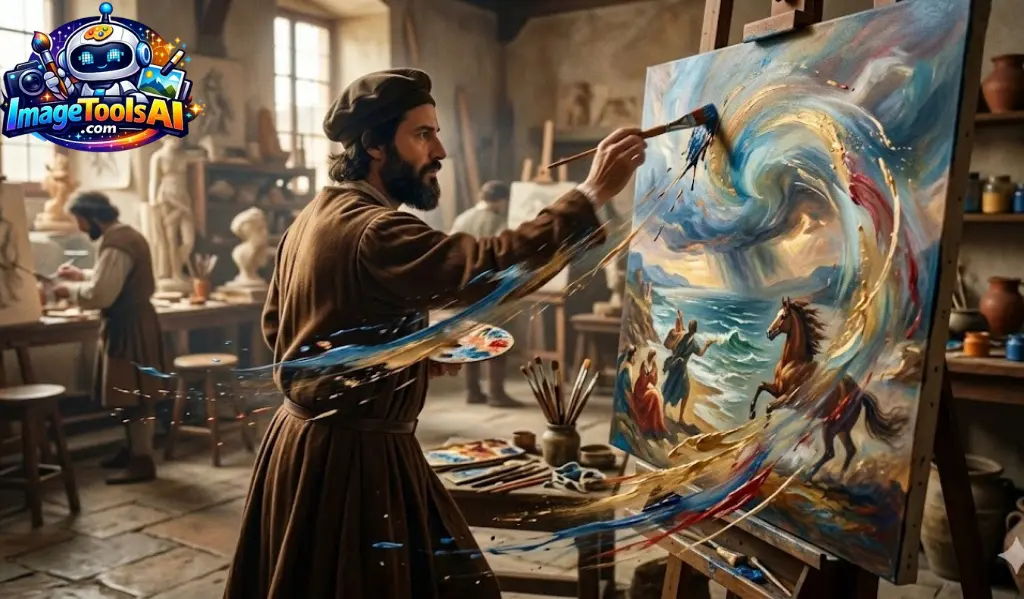
Social Media Content Creation
Creators can quickly generate:
- Reels
- Shorts
- TikToks
- Marketing Clips
- Product showcases
without advanced editing skills.
Fast Iteration
Instead of filming multiple takes, creators can generate several variations rapidly and choose the strongest result.
AI-Powered Creativity
Motion generation often introduces creative possibilities that would otherwise require expensive visual effects.
Mini Summary
Leonardo Motion combines speed, accessibility, creativity, and automation, making AI video creation more practical for creators and businesses alike.
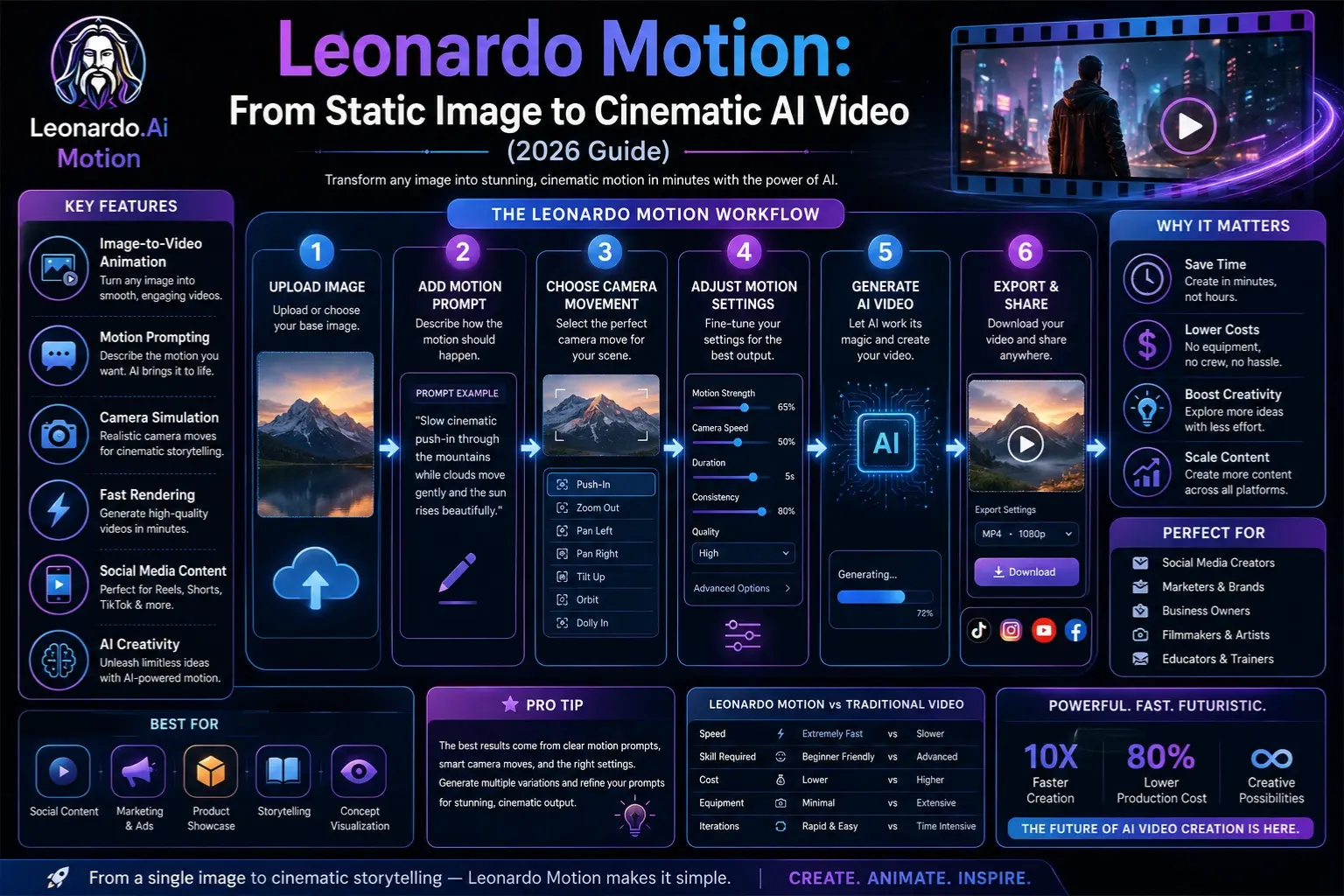
How Leonardo Motion Works
Understanding the underlying workflow helps improve results significantly.
The process generally follows four stages.
Input Image
Users upload:
- AI-generated artwork
- Product photos
- Character illustrations
- Concept art
- Photography
The image becomes the foundation for animation.
Motion Analysis
The AI examines:
- Subject placement
- Depth information
- Lighting
- Composition
- Scene structure
This helps determine how movement can be applied realistically.
Motion Generation
The model predicts how elements should move over time.
This may include:
- Object movement
- Character motion
- Environmental effects
- Camera movement
Video Rendering
The final animation sequence is rendered into a shareable video clip.
Simplified Workflow
Image → Motion Prompt → AI Processing → Animated Video
Leonardo Motion vs Traditional Video Editing
Many creators wonder whether Leonardo Motion can replace traditional editing software.
The answer depends on the project.
| Feature | Leonardo Motion | Traditional Editing |
| Speed | Extremely Fast | Slower |
| Learning Curve | Easy | Moderate to Advanced |
| Equipment Needed | Minimal | Extensive |
| Cost | Lower | Higher |
| Creative Control | Moderate | Very High |
| Animation Expertise | Not Required | Often Required |
| Scalability | Excellent | Time Intensive |
When Leonardo Motion Wins
Best for:
- Social content
- Rapid prototyping
- Marketing assets
- Concept visualization
- Creative experimentation
When Traditional Editing Wins
Best for:
- Feature films
- Advanced VFX
- Precise motion graphics
- Complex editing projects
Mini Summary
Leonardo Motion accelerates content creation dramatically but works best when paired with traditional editing workflows for larger productions.
How to Use Leonardo Motion Step-by-Step
Creating your first animation is relatively straightforward.
Create or Upload an Image
Choose a high-quality image.
Ideal characteristics:
- Sharp details
- Strong composition
- Clear subject
- Good Lighting
Poor-quality images typically produce weaker animations.
Open Motion Mode
Inside Leonardo AI, navigate to the Motion feature and select your source image.
Write a Motion Prompt
Instead of describing the image, describe the movement.
Good example:
“Slow cinematic push forward through a futuristic city while neon reflections shimmer and pedestrians move naturally.”
Bad example:
“A futuristic city with neon lights.”
The second prompt describes appearance rather than motion.
Adjust Motion Settings
Fine-tune parameters such as:
- Motion intensity
- Camera movement
- Duration
- Consistency
We’ll discuss these settings in detail next.
Generate
Run the generation and review the results.
Professional creators rarely stop after the first version.
Generate multiple variations.
Refine
Modify prompts based on outcomes.
Iterative improvements often produce better results dramatically.
Professional Tip
Generate 3–5 variations from every image.
Small changes in motion prompts frequently create significantly different results.
Understanding Leonardo Motion Settings
Many users focus only on prompts and ignore settings.
This is a major mistake.
Settings often influence results as much as prompt quality.
Motion Strength
Controls how much movement occurs.
Lower Motion Strength
Best for:
- Product videos
- Portraits
- Professional content
- Realistic scenes
Advantages:
- Stable subjects
- Consistent visuals
- Natural movement
Higher Motion Strength
Best for:
- Fantasy scenes
- Action sequences
- Dynamic environments
- Creative storytelling
Advantages:
- More dramatic effects
- Greater visual impact
- Increased energy
Camera Motion
Determines virtual camera behavior.
Common options include:
Pan
Moves horizontally across a scene.
Useful for:
- Landscapes
- Cityscapes
- Product showcases
Tilt
Moves vertically.
Useful for:
- Buildings
- Character reveals
- Environmental storytelling
Zoom
Creates depth and focus.
Useful for:
- Emotional scenes
- Product emphasis
- Cinematic reveals
Orbit
Moves around a subject.
Useful for:
- Product marketing
- Character showcases
- Luxury Advertisements
Duration
Controls video length.
Short clips often perform better on:
- TikTok
- Instagram Reels
- YouTube Shorts
Longer sequences may work better for storytelling.
Consistency Controls
Consistency settings help maintain:
- Character appearance
- Object structure
- Scene integrity
Higher consistency usually reduces visual artifacts.
Recommended Beginner Settings
| Setting | Recommended |
| Motion Strength | Medium |
| Camera Motion | Push-In |
| Duration | Short |
| Consistency | High |
| Prompt Complexity | Moderate |
These settings generally provide reliable starting results.
People Also Ask
A: Leonardo Motion is available through Leonardo AI’s platform, but access depends on your subscription plan and available generation credits. Free users may receive limited access, while premium plans typically provide higher generation limits, faster processing, and access to newer motion models.
A: Traditional video editing requires manually recording, editing, and animating footage. Leonardo Motion uses AI to automatically generate movement from a static image, significantly reducing production time and technical complexity. However, traditional editing still offers more precise control for advanced projects.
A: Leonardo Motion primarily focuses on image-to-video generation, where an existing image serves as the starting point. Depending on Leonardo AI’s latest updates, users may also combine text descriptions with image inputs to guide motion, camera movement, and scene behavior.
A: Video length depends on the current generation settings and platform limitations. Most creators use shorter clips for social media content, advertisements, product showcases, and storytelling sequences because shorter videos often generate more consistent motion quality.
A: The most effective prompts describe movement rather than appearance. Instead of describing what is already visible in the image, focus on camera actions, environmental movement, subject behavior, and cinematic effects.
Conclusion
Leonardo Motion has become one of the leading AI video tools for turning static images into engaging animations. With simple motion prompts, camera controls, and an intuitive workflow, users can quickly create professional-quality videos without complex editing skills.
Marketers, designers, businesses, and content creators use Leonardo Motion to produce social media clips, product showcases, and promotional content faster and more efficiently. Its ability to transform still images into dynamic visuals makes it a valuable addition to modern creative workflows.
While it doesn’t replace advanced video editing software, Leonardo Motion excels at rapid content creation. Strong Motion Prompts, optimized settings, and structured workflows help users achieve consistent, high-quality results.
For creators already using Leonardo AI, Motion extends the platform’s capabilities by making it easy to convert images into compelling videos. As AI video technology continues to evolve, Leonardo Motion remains a powerful tool for creating professional visual content in 2026.