Introduction
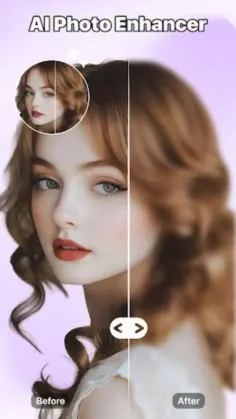
A smudged face stares from an old snapshot. Faded edges curl around a once-bright group picture. Pixels scatter when a tiny online photo fills a big display.
Picture clarity jumps forward with today’s HD Enhancement Tech. A new engine reshapes how images look now. Sharpness arrives differently through modern processing power. What was fuzzy moments ago turns crisp under this system.
Out of the blue, deep learning helps machines see better. Thanks to computer vision, they start making sense of blurry images. Neural nets chip in, spotting patterns humans might miss. Super-resolution steps up when detail feels lost. Image reconstruction fills gaps others leave behind. Enhancement tools now guess what faded faces looked like. Textures come back, not perfectly, but close. Noise fades without wiping out important bits. Low-res snapshots gain clarity, turning into something sharper. What once seemed broken gets rebuilt, one pixel at a time.
A single click might transform a faded photo into something clear. If crafting visuals is part of your work – maybe you design, market, or preserve moments – knowing what happens behind the scenes matters. Tools shaped by artificial intelligence aren’t magic, yet they sharpen and restore, because patterns guide them. Creators, photographers, and even those flipping through dusty albums at home, gain when clarity replaces blur. Behind every upgrade lies code trained on countless images. Results shift from dull to vivid, not by chance but calculation. For anyone touching visual stories, insight into these systems opens doors once stuck shut.
What Is an HD Photo Enhancement Engine?
An HD Photo Enhancement Engine is an artificial intelligence system designed to improve image quality automatically through intelligent analysis and reconstruction.
Unlike traditional editing software that merely modifies pixels, AI enhancement engines understand image content and predict what higher-quality versions should look like.
Core functions include:
- Resolution enhancement
- Face restoration
- Noise removal
- Blur correction
- Texture reconstruction
- Color recovery
- Detail generation
- Image sharpening
The goal is not simply making images larger but making them genuinely better.
Quick Definition
HD Photo Enhancement Engine: An AI-powered image processing system that uses machine learning models to reconstruct, restore, and improve image quality beyond traditional editing capabilities.
Why HD Photo Enhancement Matters in 2026
The demand for high-quality visuals continues to grow.
Modern content ecosystems require:
- Social media graphics
- E-commerce photos
- Marketing assets
- Professional portraits
- Historical archives
- Digital publishing images
Many source images are:
- Low resolution
- Compressed
- Blurry
- Noisy
- Damaged
AI enhancement bridges this quality gap.
Industries Using AI Enhancement
| Industry | Use Case |
| E-commerce | Product image improvement |
| Marketing | Campaign visuals |
| Photography | Portrait enhancement |
| Publishing | Archive restoration |
| Education | Historical preservation |
| Real Estate | Property photography |
| Social Media | Content optimization |
How an HD Photo Enhancement Engine Works
Modern systems use multiple AI models operating together.
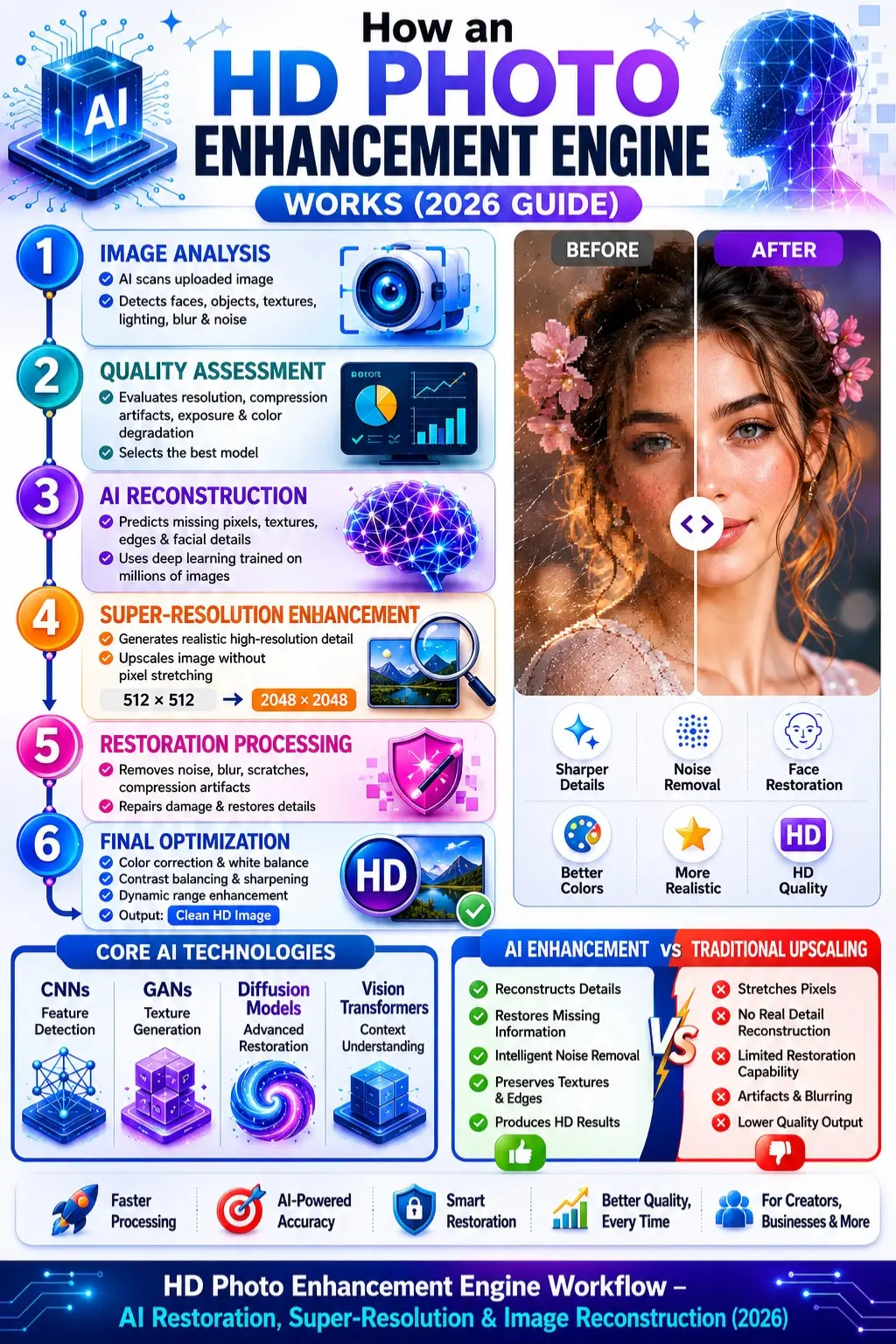
The process typically follows six stages.
Image Analysis
The AI first scans the image.
It identifies:
- Faces
- Objects
- Textures
- Backgrounds
- Lighting conditions
- Blur intensity
- Noise levels
This creates a detailed visual map.
Quality Assessment
The engine determines:
- Resolution quality
- Compression artifacts
- Color degradation
- Motion blur
- Exposure problems
Different enhancement models are then selected.
AI Reconstruction
This is where the magic happens.
The engine predicts:
- Missing pixels
- Facial details
- Texture information
- Edge structures
Rather than guessing randomly, it relies on patterns learned from millions of training images.
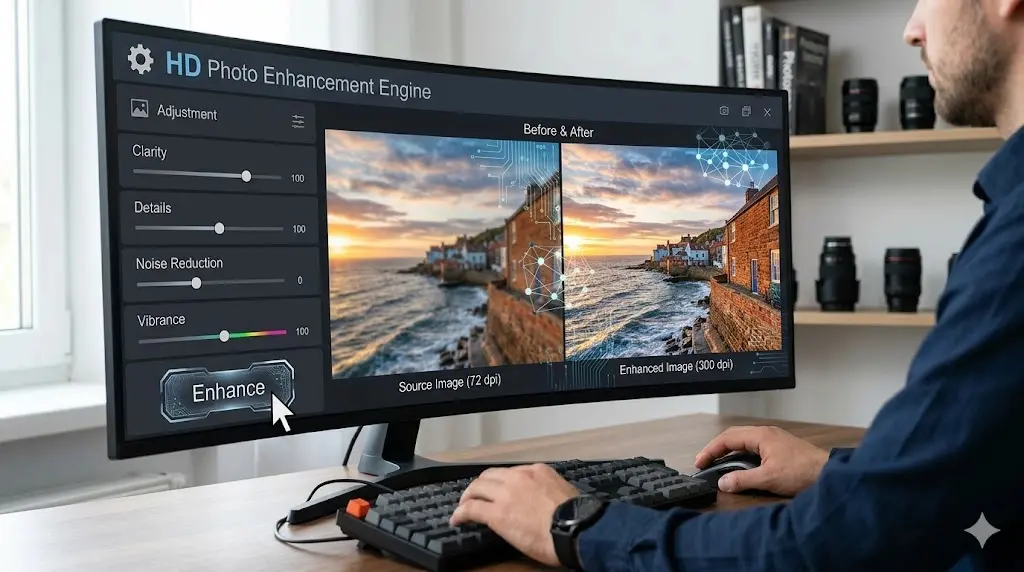
Super-Resolution Enhancement
Resolution increases through AI-generated detail reconstruction.
Instead of stretching pixels, the system creates realistic high-resolution information.
Restoration Processing
The AI removes:
- Noise
- Scratches
- Blur
- Compression damage
- Visual artifacts
Final Optimization
The image receives:
- Color balancing
- Contrast correction
- Sharpness tuning
- Dynamic range optimization
Result: a cleaner, sharper HD image.
AI Super-Resolution Technology Explained
Super-resolution forms the foundation of modern enhancement systems.
Traditional enlargement methods:
- Bicubic scaling
- Bilinear scaling
- Nearest-neighbor interpolation
These methods simply stretch existing pixels.
AI super-resolution does something entirely different.
It learns relationships between:
- Shapes
- Edges
- Patterns
- Textures
The model then reconstructs details that should exist in a higher-resolution version.
Example
Original Image:
512 × 512
Enhanced Outputs:
- 1024 × 1024
- 2048 × 2048
- 4096 × 4096
while maintaining visual realism.
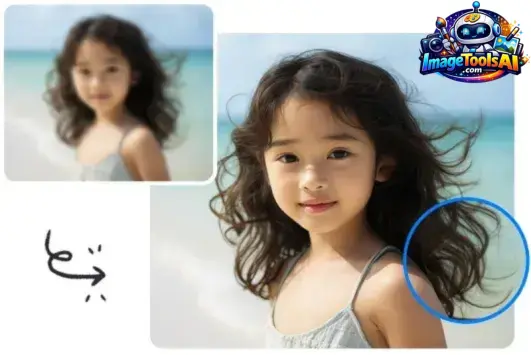
Face Reconstruction and Enhancement
Human faces are among the most difficult image elements to restore.
Modern enhancement engines include specialized facial restoration networks.
These systems identify:
- Eyes
- Eyelashes
- Eyebrows
- Nose
- Lips
- Hairline
- Jaw structure
Face enhancement models are trained on enormous facial datasets to understand realistic anatomy.
Benefits
- Sharper Portraits
- Better facial recognition
- Improved identity preservation
- More realistic restorations

Deep Learning Models Behind HD Enhancement
Several AI architectures power modern systems.
Convolutional Neural Networks
CNNs remain the backbone of many image enhancement systems.
Strengths:
- Feature extraction
- Edge detection
- Pattern recognition
Generative Adversarial Networks
GANs consist of:
- Generator
- Discriminator
The generator creates enhanced images.
The discriminator judges realism.
This competition improves output quality.
Advantages
- Realistic textures
- Better face restoration
- Enhanced visual detail
Diffusion Models
Diffusion technology has become increasingly important in 2026.
Benefits include:
- Better consistency
- Reduced artifacts
- More natural details
- Superior image restoration
Diffusion systems often outperform older GAN-only solutions.
Vision Transformers
Transformers bring contextual understanding to images.
Advantages:
- Global image awareness
- Better reconstruction accuracy
- Improved scalability
Many next-generation enhancement engines combine CNNs, transformers, and diffusion models.
GAN vs Diffusion Models
| Feature | GAN | Diffusion |
| Speed | Faster | Slower |
| Detail Quality | High | Very High |
| Realism | Excellent | Superior |
| Stability | Moderate | High |
| Artifact Control | Good | Better |
| Restoration Accuracy | High | Very High |
For professional restoration, diffusion-based systems are increasingly preferred.
AI Enhancement vs Traditional Editing
| Feature | Traditional Editing | AI Enhancement |
| Upscaling | Pixel Stretching | Detail Generation |
| Face Recovery | Limited | Advanced |
| Noise Removal | Basic | Intelligent |
| Restoration | Manual | Automated |
| Reconstruction | None | Extensive |
| Speed | Slower | Faster |
Key Benefits for Creators and Businesses
Creators
- Better social media images
- Improved engagement
- Faster workflows
- Higher-quality portfolios
Businesses
- Better product photos
- Professional branding
- Improved advertising assets
- Enhanced customer trust
Photographers
- Old photo restoration
- Client portrait enhancement
- Print-ready outputs
Best Use Cases
Photo Restoration
Recover:
- Family photographs
- Historical images
- Damaged prints
Social Media Content
Improve:
- Instagram posts
- Pinterest graphics
- Facebook content
E-Commerce
Enhance:
- Product photography
- Catalog images
- Marketplace Listings
Marketing Campaigns
Create:
- HD advertisements
- Website visuals
- Promotional materials
Realistic Expectations and Limitations
AI enhancement is powerful but not magical.
Hallucinated Details
AI may generate details that never existed.
Extreme Damage
Severely degraded photos remain challenging.
Identity Changes
Facial reconstruction can sometimes alter subtle features.
Computational Cost
Advanced models require significant processing power.
Mini Summary
AI enhancement improves image quality dramatically, but cannot perfectly recover information that was never captured.
Privacy, Safety, and Commercial Use
Before uploading images:
- Review privacy policies
- Check commercial licenses
- Understand data retention practices
- Verify copyright ownership
Businesses should prioritize tools with transparent policies and enterprise-grade security.
Future of HD Photo Enhancement
The next generation of engines will likely include:
- Real-time enhancement
- Video restoration
- 3D reconstruction
- Personalized AI models
- Context-aware restoration
- Multi-frame enhancement
Future systems may reconstruct historical photographs with unprecedented realism.
Who Should Use an HD Photo Enhancement Engine?
Ideal users:
- Content creators
- Marketers
- Photographers
- Designers
- Agencies
- E-commerce businesses
- Students
- Researchers
Who Should Avoid It?
May not be necessary for:
- Users with already high-quality images
- Projects requiring strict forensic accuracy
- Images needing manual artistic control
People Also Ask
A: Yes. Modern systems generate predicted details based on patterns learned from training data. These details are realistic but may not perfectly match the original scene.
A: In most cases, yes. AI systems reconstruct details while sharpening only increases edge contrast.
A: Often yes. AI can reduce damage, remove noise, improve clarity, and reconstruct facial features, though results vary based on photo condition.
A: Super-resolution is an AI technique that increases image resolution while generating realistic detail rather than simply enlarging pixels.
A: Not entirely. Many modern solutions combine both approaches, but diffusion models are becoming increasingly popular for high-quality restoration.
Conclusion
Picture clarity gets a serious upgrade thanks to smart software that learns patterns from tons of photos. Instead of guessing what’s missing, it fills gaps using trained logic built from real image data. Starting with fuzzy or broken snapshots, the system rebuilds details bit by bit. Where old tools failed, new methods step in – using layered analysis to sharpen faces, textures, and edges. Noise fades out while structure comes forward, Frame by Frame. Broken pixels get reimagined based on how light and shape behave in similar scenes. Quality jumps up without inventing fake realism. The result? Usable images pulled back from near loss.
Picture takers, companies, promoters, makers, even regular folks – tech tools speed things up. Smoother steps in getting work done show right away in sharper images. Fresh ways to keep moments alive pop up. Polished output becomes easier to reach. Each upgrade opens doors that were shut before.
By 2026, improvement tools will likely grow sharper, more precise, still moving on their own. Realness might deepen simply because systems learn faster now.
Starting fresh with AI image tech? Sharpness matters early on. That’s where HD upgrades fit right in. Over at ImageToolsAI.com, updates roll out regularly – new methods, fresh tools, and insights into what’s next for artificial intelligence in visuals appear often there.