Introduction
AI image generation has become an essential part of modern content creation, but one challenge remains common across most models: getting exactly what you ask for.
Many AI image generators can produce stunning visuals, yet they often ignore parts of prompts, misplace objects, generate unreadable text, or create inconsistent results. This becomes a major problem for marketers, designers, agencies, ecommerce brands, and content creators who need reliable outputs.
Leonardo Phoenix was built to solve that problem.
As Leonardo AI’s flagship image-generation model, Phoenix focuses on prompt adherence and visual accuracy, helping creators produce more predictable, professional-quality images with fewer iterations. Whether you’re generating marketing graphics, product photography, social media content, concept art, branding assets, or cinematic visuals, Phoenix offers a powerful combination of creative freedom and control.
In this comprehensive guide, you’ll learn how Leonardo Phoenix works, its best settings, advanced prompt formulas, professional workflows, industry use cases, expert tips, limitations, and how it compares with other leading AI image models in 2026.
What Is Leonardo Phoenix?
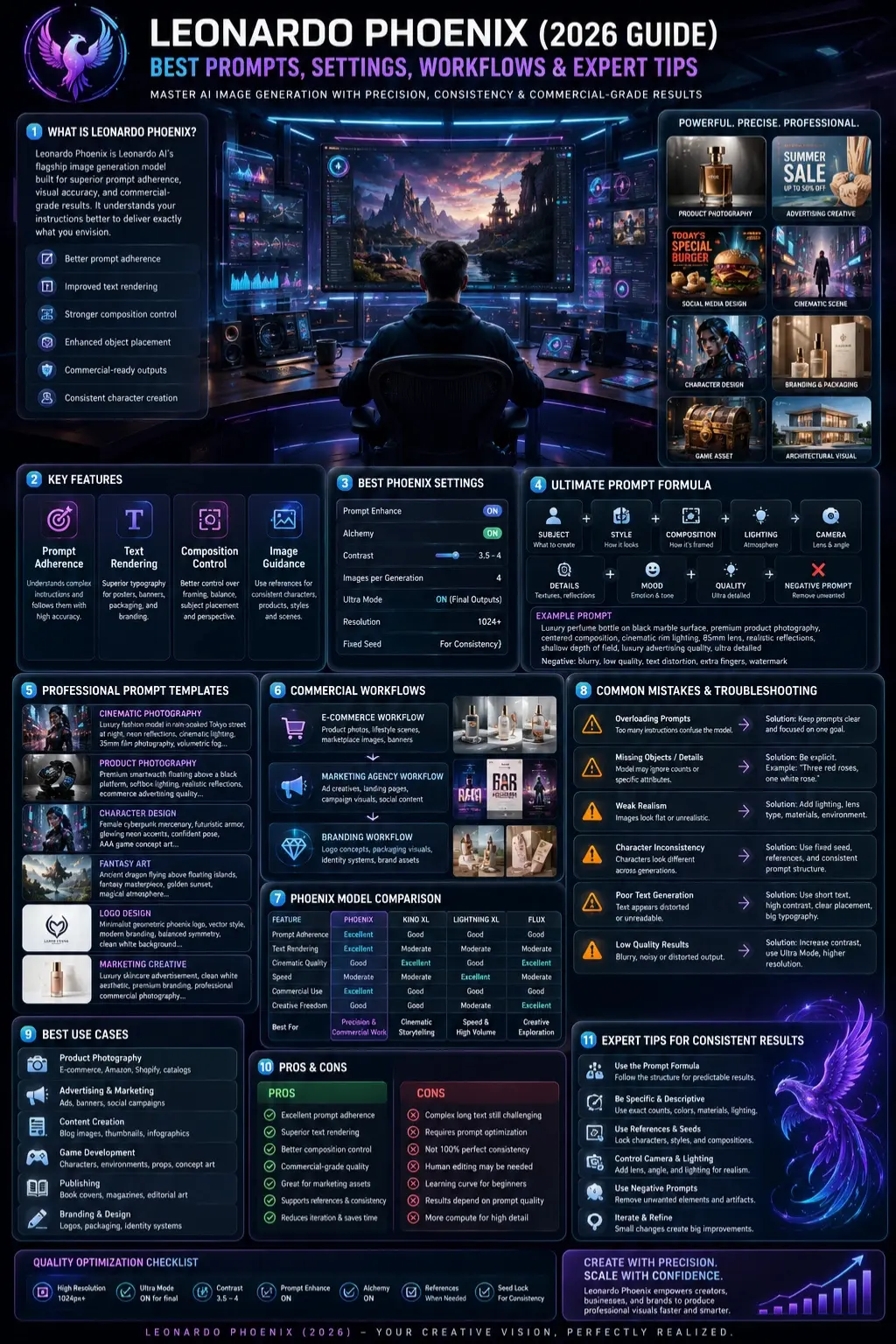
Leonardo Phoenix is an advanced AI image generation model developed by Leonardo AI. Unlike many traditional diffusion models that loosely interpret prompts, Phoenix was specifically designed to improve instruction following and visual consistency.
The model focuses on:
- Better prompt adherence
- Improved text rendering
- Stronger composition control
- Enhanced object placement
- Commercial-grade image generation
- Consistent character creation
For creators who need precision rather than randomness, Phoenix has become one of the most practical AI image generation models available.
Why Creators Prefer Phoenix
Many users switch to Phoenix because it helps reduce:
- Prompt frustration
- Failed generations
- Repetitive iterations
- Editing time
- Production costs
In commercial environments, those advantages can save significant time and resources.
How Leonardo Phoenix Works
Leonardo Phoenix uses an advanced generative AI architecture designed to better understand natural language instructions.
Instead of focusing purely on artistic creativity, Phoenix prioritizes understanding relationships between:
- Subjects
- Objects
- Positions
- Colors
- Text
- Lighting
- Composition
This enables the model to generate images that more closely match the user’s intent.
Core Workflow
- User enters prompt
- Phoenix analyzes instruction hierarchy
- Model interprets scene relationships
- Image is generated
- User refines with references or prompt adjustments
This workflow creates greater control compared to many earlier AI image models.

Why Leonardo Phoenix Matters in 2026
The AI content industry has shifted from experimentation to production.
Businesses now require:
- Consistent branding
- Fast content creation
- Commercial reliability
- Scalable visual assets
- Predictable outputs
Phoenix addresses these demands by focusing on controllability and prompt fidelity.
Growing Demand for Visual Content
Organizations increasingly need:
- Product photos
- Social media graphics
- Blog images
- Advertising creatives
- Website visuals
- Video thumbnails
Phoenix helps generate these assets faster while maintaining quality.
Key Features of Leonardo Phoenix
Exceptional Prompt Adherence
Prompt adherence remains Phoenix’s biggest strength.
Benefits include:
- Better instruction following
- Accurate object placement
- Improved scene understanding
- Reduced prompt confusion
- More predictable results
Example
Prompt:
“Three red apples on a wooden table with one green apple beside them.”
Many models may ignore counts or colors.
Phoenix is significantly more likely to follow the instructions accurately.
Improved Text Rendering
Text generation has historically been difficult for image models.
Phoenix performs better when generating:
- Posters
- Packaging
- Advertisements
- Book covers
- Social media graphics
- Product mockups
Best Practice
Keep text short.
Examples:
Summer Sale
Grand Opening
New Collection
Long paragraphs remain challenging for all AI image models.
Better Composition Control
Phoenix excels at understanding visual structure.
Useful for:
- Product photography
- Marketing creatives
- Editorial designs
- Commercial advertising
Users gain more control over:
- Subject positioning
- Camera framing
- Visual balance
- Scene hierarchy
Image Guidance Support
Phoenix supports image references to improve consistency.
Applications include:
- Character consistency
- Brand consistency
- Product consistency
- Style Replication
This feature is especially useful for agencies and businesses producing multiple assets.
Best Leonardo Phoenix Settings
The following settings provide a strong starting point for most professional projects.
| Setting | Recommended |
| Prompt Enhance | ON |
| Alchemy | ON |
| Contrast | 3.5–4 |
| Images per Generation | 4 |
| Ultra Mode | ON for final outputs |
| Resolution | 1024+ |
| Fixed Seed | For consistency |
Photorealism Settings
| Setting | Value |
| Prompt Enhance | ON |
| Alchemy | ON |
| Resolution | 1536+ |
| Ultra Mode | ON |
| Contrast | 4 |
Concept Art Settings
| Setting | Value |
| Prompt Enhance | ON |
| Alchemy | ON |
| Contrast | 3 |
| Ultra Mode | Optional |
| Resolution | 1024 |
The Ultimate Leonardo Phoenix Prompt Formula
The highest-performing prompts generally follow this structure:
Subject + Style + Composition + Lighting + Camera + Details + Mood + Quality Modifiers + Negative Prompt
Example
Luxury perfume bottle on black marble surface, premium product photography, centered composition, cinematic rim lighting, 85mm lens, realistic reflections, shallow depth of field, luxury advertising quality, ultra detailed
Why This Formula Works
It tells Phoenix:
- What to create
- How it should look
- How it should be framed
- What atmosphere to generate
The result is significantly more controlled output.

Best Leonardo Phoenix Prompt Templates
Cinematic Photography Prompt
Luxury fashion model standing in rain-soaked Tokyo street at night, neon reflections, cinematic lighting, 35mm film photography, volumetric fog, dramatic shadows, shallow depth of field, editorial magazine quality
Product Photography Prompt
Premium smartwatch floating above a black platform, luxury studio photography, softbox lighting, realistic reflections, ecommerce advertising quality, ultra-detailed product render
Character Design Prompt
Female cyberpunk mercenary, futuristic armor, glowing neon accents, confident pose, cinematic lighting, highly detailed facial features, AAA game concept art
Fantasy Art Prompt
Ancient dragon flying above floating islands, fantasy masterpiece, golden sunset, magical atmosphere, intricate details, epic cinematic composition
Game Asset Prompt
Fantasy treasure chest, stylized game asset, isolated background, clean silhouette, vibrant colors, professional game development asset sheet
Logo Design Prompt
Minimalist geometric phoenix logo, vector style, modern branding, balanced symmetry, premium startup identity, clean white background
Marketing Creative Prompt
Luxury skincare product advertisement, clean white aesthetic, premium branding, professional commercial photography, and social media campaign quality
Advanced Commercial Workflows
E-commerce Workflow
Generate:
- Product hero images
- Lifestyle photography
- Marketplace visuals
- Promotional banners
Benefits:
- Faster content production
- Lower photography costs
- Rapid testing
Marketing Agency Workflow
Create:
- Ad creatives
- Landing page graphics
- Campaign visuals
- Social media content
Phoenix is particularly useful when clients require rapid revisions.
Branding Workflow
Develop:
- Logo concepts
- Brand mascots
- Packaging visuals
- Identity systems
The model’s prompt adherence improves design exploration.
Leonardo Phoenix vs Other Models
Leonardo Phoenix vs Kino XL
| Feature | Phoenix | Kino XL |
| Prompt Adherence | Excellent | Good |
| Cinematic Style | Good | Excellent |
| Text Rendering | Excellent | Moderate |
| Marketing Assets | Excellent | Good |
| Commercial Design | Excellent | Good |
Winner
Choose Phoenix for precision and commercial work.
Choose Kino XL for cinematic storytelling.
Leonardo Phoenix vs Lightning XL
| Feature | Phoenix | Lightning XL |
| Quality | Higher | Good |
| Speed | Moderate | Excellent |
| Accuracy | Excellent | Good |
| Prompt Control | Excellent | Moderate |
Winner
Phoenix for quality.
Lightning XL for speed.
Leonardo Phoenix vs Flux
| Feature | Phoenix | Flux |
| Commercial Work | Excellent | Good |
| Creative Freedom | Good | Excellent |
| Prompt Adherence | Excellent | Good |
| Text Rendering | Excellent | Moderate |
Winner
Phoenix for business.
Flux for experimentation.
Best Use Cases for Leonardo Phoenix
Product Photography
Create:
- E-commerce listings
- Amazon images
- Shopify visuals
- Product campaigns
Advertising
Generate:
- Social ads
- Display banners
- Campaign creatives
- Promotional graphics
Content Marketing
Produce:
- Blog visuals
- Thumbnails
- Infographics
- Website graphics
Game Development
Create:
- Characters
- Environments
- Props
- Asset concepts
Publishing
Generate:
- Book covers
- Magazine illustrations
- Editorial artwork
Common Phoenix Mistakes
Overloading Prompts
Too many instructions often reduce quality.
Instead:
Focus on one clear objective.
Ignoring Composition
Specify:
- Close-up
- Medium shot
- Wide shot
- Top-down view
Composition dramatically affects output.
No Negative Prompt
Remove unwanted artifacts with negative prompts.
Example:
blurry, low quality, distorted anatomy, extra fingers, watermark
Constantly Changing Descriptions
For consistency, keep core descriptions stable.
Troubleshooting Poor Results
Missing Objects
Solution:
Use explicit counts.
Example:
Three red roses, one white rose.
Weak Realism
Solution:
Add:
- Lens types
- Lighting styles
- Material descriptions
Character Changes
Solution:
Use:
- Fixed seed
- Character references
- Consistent prompt foundations
Poor Text Generation
Solution:
Keep text short.
Use:
- Large typography
- High contrast
- Clear placement instructions
Privacy, Safety & Commercial Usage
Before using Phoenix commercially:
Verify:
- Current licensing terms
- Commercial rights
- Platform policies
- Intellectual property guidelines
Businesses should regularly review official Leonardo AI documentation to ensure compliance.
Realistic Expectations & Limitations
Phoenix is powerful, but not perfect.
Strengths
- Excellent prompt adherence
- Strong commercial usability
- Better text rendering
- Reliable composition control
Limitations
- Complex text remains difficult
- Perfect consistency still requires references
- Human editing may still be necessary
- Results depend on prompt quality
Understanding these limitations helps set realistic expectations.
Who Should Use Leonardo Phoenix?
Phoenix is ideal for:
- Marketers
- Designers
- Agencies
- E-commerce brands
- Content creators
- Bloggers
- Small businesses
- Game Developers
- Publishers
Who Should Avoid Phoenix?
Phoenix may not be ideal for:
- Users seeking maximum artistic randomness
- Pure experimentation workflows
- Hobbyists prioritizing speed over quality
Alternative models may better fit those needs.
Future of Leonardo Phoenix
The future of AI image generation is moving toward:
- Better prompt understanding
- Improved editing capabilities
- Stronger consistency tools
- Enhanced image guidance
- Better multimodal workflows
Phoenix is well-positioned to remain one of the leading models for professional image generation as these capabilities evolve.
People Also Ask
A: Yes. Phoenix can generate highly realistic images when combined with strong lighting, camera, and material descriptions.
A: Yes. Text rendering is one of its strongest features compared with many traditional AI image models.
A: For prompt adherence, commercial design, and marketing workflows, Phoenix is generally the stronger option.
A: Marketing, e-commerce, publishing, game development, branding, and content creation benefit significantly from its controllability.
A: Yes. Using seeds, references, and consistent prompts can dramatically improve character consistency across projects.
Pros and Cons
| Pros | Cons |
| Excellent prompt adherence | The complex text still challenging |
| Strong text rendering | Requires prompt optimization |
| Better composition control | Not always perfectly consistent |
| Great for commercial work | Some editing may still be needed |
| Reliable marketing asset creation | Learning curve for beginners |
Conclusion
Out of nowhere, Leonardo Phoenix stands among the top AI tools for creating images in 2026. Because it follows prompts well, frames scenes correctly, handles text neatly, and remains fit for business use, many pros rely on it. While quality matters, predictability matters more; this model delivers both without fuss.
From product shots to social posts, Phoenix shapes how ideas flow without losing precision. Not stuck in one way of working, it bends when needed yet holds firm where it counts. Branding, games, ads, or Magazine Images – each step stays guided but never rigid. Creative room exists alongside clear direction, no matter the task.
Imagine getting what you actually ask for – Phoenix changes that game. When prompts click just right, pictures come out sharper than before. Tweak the steps shown here, then watch how fast things get done. Fewer tries mean less waiting around. Results start looking like each other in a good way.
For anyone diving into AI-driven content, Leonardo Phoenix fits right in. Jump into deeper tutorials on generating images with AI, see how models stack up, and explore prompts