Introduction
AI image generation has changed dramatically over the past few years.
What started as experimental AI art has now evolved into a serious commercial production industry used by creators, marketers, brands, filmmakers, and businesses worldwide.
In 2026, simply generating beautiful images is no longer enough.
Modern creators need:
- consistent visual branding
- cinematic image quality
- fast iteration
- commercial-ready outputs
- prompt control
- scalable workflows
That’s exactly why Leonardo Diffusion has become one of the most talked-about AI image systems in the creator economy.
Unlike many AI art generators that prioritize randomness or abstract artistic styles, Leonardo focuses heavily on controllable, production-ready image generation. The platform combines Stable Diffusion technology with advanced workflow tools, consistency systems, real-time editing, and creator-focused automation.
Today, creators use Leonardo for:
- YouTube thumbnails
- ecommerce creatives
- game assets
- cinematic storytelling
- social media campaigns
- AI filmmaking
- digital advertising
- brand identity systems
In this complete guide, you’ll learn how Leonardo Diffusion works, which models matter most, how professionals build workflows around it, and whether it’s actually better than Midjourney, Flux, or Stable Diffusion for modern creators.
What Is Leonardo Diffusion?
Leonardo Diffusion is Leonardo AI’s advanced image-generation ecosystem built around diffusion-based AI models and creator workflow tools.
At its core, the platform uses Stable Diffusion-style generative technology enhanced with proprietary optimization systems designed for commercial image production.
Leonardo combines multiple capabilities into one workflow platform:
- text-to-image generation
- image-to-image transformation
- AI upscaling
- realtime canvas editing
- prompt enhancement
- motion generation
- style consistency
- fine-tuned AI models
- creator automation workflows
The platform has become especially popular because it balances:
| Strength | Why It Matters |
| Quality | Cinematic and polished visuals |
| Control | Better prompt steering |
| Speed | Fast generation workflows |
| Consistency | Reliable multi-image branding |
| Scalability | Useful for agencies and teams |
Unlike many AI generators that produce unpredictable results, Leonardo emphasizes repeatability and production efficiency.
That difference matters enormously for professional creators.
How Leonardo Diffusion Works
Leonardo Diffusion uses a neural diffusion architecture to generate images from text prompts.
The system gradually transforms random visual noise into detailed images using learned visual patterns.
However, Leonardo goes beyond basic diffusion generation by layering multiple creator-focused systems on top.
Core Workflow Pipeline
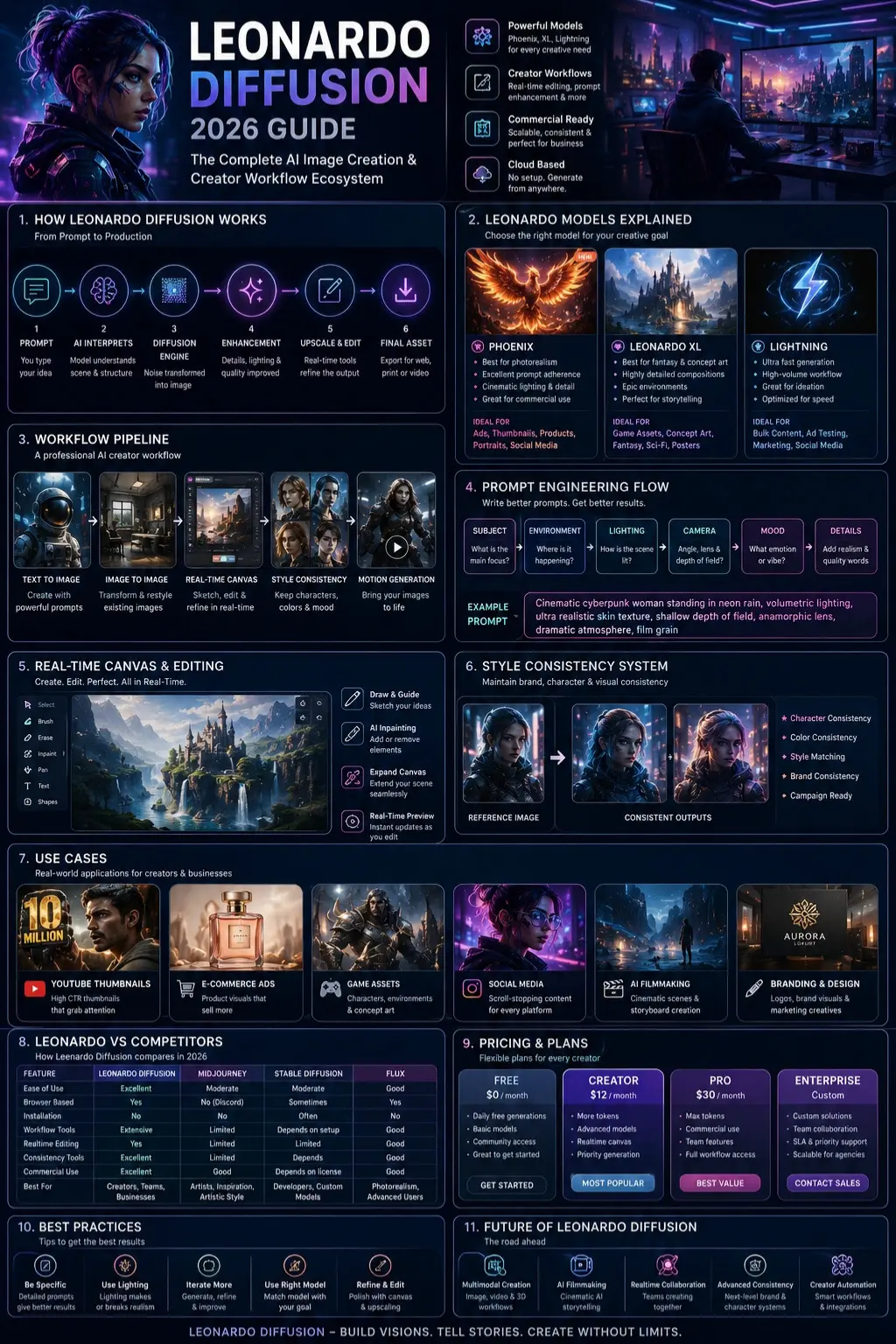
A typical Leonardo workflow looks like this:
- User enters a prompt
- AI model interprets scene structure
- Style systems apply visual consistency
- Diffusion engine generates a composition
- Enhancement systems improve detail
- Upscaling and editing refine output
- Final assets export for production use
Why Leonardo Feels Different
Most open-source Stable Diffusion tools require:
- manual installations
- GPU configuration
- model downloads
- plugin management
- technical setup
Leonardo removes most of that complexity.
Everything runs through a polished browser-based interface optimized for creators instead of engineers.
That usability advantage is one reason Leonardo expanded so quickly among marketers and content creators.
Why Leonardo Diffusion Matters in 2026
The AI image market has become extremely competitive.
Tools like Midjourney, Flux, DALL·E-style systems, Firefly, and SDXL all compete for attention.
So why are creators still moving toward Leonardo?
Because the industry is shifting away from “AI art experiments” toward full production ecosystems.
Modern creators need:
- workflow speed
- scalable output
- brand consistency
- collaboration
- editing control
- multimodal content pipelines
Leonardo aligns closely with that trend.
Instead of functioning merely as an image generator, it behaves more like a creator-infrastructure platform.
That positioning makes it especially attractive for:
- agencies
- YouTubers
- e-commerce businesses
- design teams
- AI filmmakers
- social media creators
Leonardo Diffusion Models Explained
One of Leonardo’s biggest advantages is its growing model ecosystem.
Different models specialize in different visual goals.
Leonardo Diffusion XL
Leonardo Diffusion XL focuses on:
- cinematic compositions
- fantasy scenes
- stylized realism
- highly detailed artwork
- concept art generation
It performs particularly well for:
- gaming environments
- sci-fi visuals
- fantasy worlds
- cinematic posters
- creative storytelling
Best Use Cases
- RPG asset generation
- concept illustration
- AI movie posters
- environment ideation
- digital art production
Phoenix Model
Phoenix became Leonardo’s flagship commercial model because of its strong prompt adherence and realistic rendering quality.
Key Strengths
- Cleaner Anatomy
- realistic lighting
- sharper detail
- cinematic rendering
- better text interpretation
- more stable compositions
Creators frequently use Phoenix for:
- YouTube thumbnails
- advertising creatives
- social media campaigns
- AI influencer imagery
- product photography concepts
Phoenix is widely considered one of Leonardo’s strongest commercial-generation models.
Lightning Models
Lightning models prioritize speed over maximum detail.
These models are optimized for:
- rapid ideation
- high-volume generation
- fast iteration
- marketing pipelines
Best For
- agencies
- ecommerce teams
- ad testing
- social media content
- bulk visual production
Lightning models are particularly valuable when teams need dozens or hundreds of visual variations quickly.
Leonardo Diffusion vs Stable Diffusion
Many users confuse Leonardo Diffusion with Stable Diffusion.
They are related, but not identical.
The Main Difference
Stable Diffusion is the underlying open-source technology foundation.
Leonardo Diffusion is a commercial workflow ecosystem built on top of diffusion-based systems.
| Feature | Leonardo Diffusion | Stable Diffusion |
| Ease of Use | Excellent | Moderate |
| Browser-Based | Yes | Sometimes |
| Installation Needed | No | Often |
| Fine-Tuning Workflow | Simplified | Technical |
| Realtime Editing | Yes | Limited |
| Creator Workflow Tools | Extensive | Depends on setup |
| Team Collaboration | Better | Limited |
| Beginner Friendly | High | Lower |
Which One Is Better?
Choose Stable Diffusion if you want:
- complete customization
- self-hosting
- developer control
- open-source flexibility
Choose Leonardo if you want:
- fast production workflows
- simplicity
- cloud-based generation
- creator-focused tools
- commercial usability
For most non-technical creators, Leonardo is dramatically easier to use.
Leonardo Diffusion vs Midjourney
This is one of the biggest comparisons in AI image generation today.
Midjourney Strengths
Midjourney is known for:
- artistic beauty
- dramatic mood
- cinematic compositions
- stylized visuals
- painterly aesthetics
Leonardo Strengths
Leonardo focuses more on:
- workflow control
- consistency systems
- realtime editing
- production scalability
- commercial pipelines
| Category | Midjourney | Leonardo Diffusion |
| Artistic Style | Excellent | Very Good |
| Prompt Control | Moderate | Strong |
| Brand Consistency | Limited | Excellent |
| Editing Workflow | Limited | Strong |
| Commercial Production | Good | Excellent |
| Ease of Scaling | Moderate | Strong |
| Realtime Tools | Limited | Advanced |
What Professionals Often Do
Many advanced creators now combine both tools:
- Midjourney for inspiration
- Leonardo for production workflows
That hybrid pipeline is becoming increasingly common across creative industries.
Best Leonardo Diffusion Features
Realtime Canvas
Realtime Canvas allows users to sketch ideas and refine images interactively.
This feature helps creators:
- brainstorm faster
- modify compositions visually
- iterate in real time
- refine scenes naturally
For many creators, this is Leonardo’s most unique feature.
Prompt Enhancement
Leonardo can automatically improve prompts by adding:
- lighting cues
- cinematic composition
- realism modifiers
- texture detail
- environmental depth
This helps beginners achieve stronger outputs without advanced prompt-engineering knowledge.
Style Consistency Systems
Consistency is one of the hardest challenges in AI image generation.
Leonardo’s style systems help maintain:
- character identity
- visual branding
- color consistency
- campaign cohesion
- storytelling continuity
This is critical for:
- YouTube channels
- ecommerce brands
- agencies
- AI influencers
- comic projects
Motion Generation
Leonardo is expanding into multimodal AI creation.
Modern workflows increasingly include:
- image-to-video
- motion effects
- animated storytelling
- cinematic transitions
This reflects where the AI creator industry is heading overall.
How to Use Leonardo Diffusion (Step-by-Step)
Create an Account
Sign up through Leonardo’s platform and access the dashboard.
Most users begin with the free generation tier.
Choose a Model
Select the right model based on your goal.
| Goal | Recommended Model |
| Photorealism | Phoenix |
| Fantasy Art | Leonardo XL |
| Fast Content | Lightning |
| Social Media | Phoenix |
| Concept Art | Leonardo XL |
Write a Strong Prompt
Good prompts typically include:
- subject
- environment
- lighting
- camera angle
- mood
- detail modifiers
Example Prompt
“cinematic cyberpunk woman standing in neon rain, volumetric lighting, ultra realistic skin texture, shallow depth of field, anamorphic lens, dramatic atmosphere, film grain”
Adjust Settings
Important settings include:
- guidance scale
- image dimensions
- prompt strength
- seed control
- style presets
Generate Variations
Professional creators rarely stop after one generation.
Instead, they:
- test multiple prompts
- refine compositions
- iterate lighting
- optimize framing
- improve realism
Iteration is a major part of professional AI workflows.
Best Leonardo Diffusion Prompting Strategies
Prompt engineering heavily impacts image quality.
Cinematic Prompt Formula
A strong cinematic prompt usually follows this structure:
Subject + Environment + Lighting + Camera Style + Mood + Detail Modifiers
Example
“futuristic samurai in rainy Tokyo alley, neon reflections, cinematic lighting, ultra detailed armor, shallow depth of field, realistic skin texture, dramatic atmosphere”
Best Prompt Keywords
Realism
- ultra realistic
- cinematic lighting
- highly detailed
- natural skin texture
- depth of field
Fantasy
- epic fantasy
- mystical atmosphere
- volumetric fog
- magical lighting
- cinematic composition
Product Photography
- studio lighting
- soft shadows
- realistic reflections
- clean background
- luxury aesthetic

Best Leonardo Diffusion Use Cases
YouTube Thumbnail Creation
Leonardo performs extremely well for YouTube creators because it can generate:
- emotional faces
- cinematic scenes
- dramatic lighting
- branded visuals
- attention-grabbing compositions
Consistency tools help channels maintain a recognizable visual identity across videos.
E-commerce Marketing
E-commerce brands use Leonardo for:
- product mockups
- ad creatives
- social media ads
- seasonal campaigns
- AI Lifestyle Photography
This can significantly reduce photography and design costs.
Game Development
Leonardo is highly popular among indie developers.
Common use cases include:
- character design
- environment ideation
- fantasy creatures
- texture concepts
- cinematic key art
Agency Workflows
Creative agencies increasingly use Leonardo for:
- rapid ideation
- client moodboards
- advertising visuals
- campaign testing
- scalable creative production
This dramatically accelerates content delivery pipelines.
Leonardo Diffusion Pricing
Leonardo offers both free and paid plans.
The platform typically includes:
- daily free generations
- creator subscriptions
- premium commercial tiers
- enterprise scaling options
Pricing Strengths
- generous free access
- scalable creator plans
- cloud-based workflow
- no GPU requirements
Potential Drawbacks
- Token systems can become expensive at scale
- High-volume workflows may require upgrades
- Enterprise usage costs vary
Always verify current pricing directly through official sources because AI platform pricing changes frequently.
Pros and Cons of Leonardo Diffusion
| Pros | Cons |
| Excellent workflow control | Some rivals have stronger artistic aesthetics |
| Strong consistency tools | Token costs may increase |
| Realtime editing features | Advanced features require experimentation |
| Beginner friendly | Some outputs still need editing |
| Commercial scalability | Photorealism can vary by model |
| Fast iteration | Heavy generation users may hit limits |
Best Alternatives to Leonardo Diffusion
Midjourney
Best for:
- artistic imagery
- cinematic aesthetics
- stylized artwork
Flux
Best for:
- advanced photorealism
- realistic textures
- modern image fidelity
Adobe Firefly
Best for:
- Adobe ecosystem users
- commercial-safe workflows
- enterprise creative teams
Stable Diffusion
Best for:
- open-source flexibility
- custom training
- technical experimentation
Common Leonardo Diffusion Mistakes to Avoid
Overloading Prompts
Too many modifiers can confuse image generation.
Keep prompts descriptive but focused.
Ignoring Lighting Details
Lighting dramatically impacts realism.
Always specify:
- cinematic lighting
- natural lighting
- studio lighting
- neon lighting
- golden hour lighting
Using the Wrong Model
Different models perform better for different goals.
Always match the model to the task.
Expecting Perfect Results Instantly
Professional creators iterate constantly.
Strong AI visuals usually require multiple generations and refinements.
Expert Prompt Templates
Cinematic Portrait
“cinematic close-up portrait of a futuristic traveler, neon city background, volumetric lighting, realistic skin texture, shallow depth of field, ultra detailed, film grain”
E-commerce Product Ad
“luxury smartwatch on reflective black surface, studio lighting, realistic shadows, premium commercial photography style, ultra realistic, clean composition”
Fantasy Environment
“massive fantasy castle on a floating island, glowing waterfalls, mystical atmosphere, cinematic clouds, epic scale, highly detailed fantasy artwork”
Privacy, Safety & Commercial Use
Before using Leonardo commercially, creators should review:
- licensing terms
- commercial usage rights
- AI training policies
- copyright guidelines
- platform restrictions
Important Considerations
- AI outputs may still require editing
- Trademarked content can create risks
- Commercial campaigns should include human review
- licensing rules may evolve over time
Businesses should always verify current policies directly through official documentation.
Future AI Image Trends
The AI image industry is rapidly moving toward:
- multimodal workflows
- AI filmmaking
- realtime collaboration
- AI avatars
- motion generation
- brand consistency systems
- AI-assisted storytelling
Leonardo is positioning itself around full creator infrastructure instead of standalone image generation.
That could become a major competitive advantage over the next several years.
Who Should Use Leonardo Diffusion?
Leonardo is ideal for:
- YouTubers
- marketers
- ecommerce brands
- agencies
- social media creators
- indie game developers
- AI filmmakers
- freelancers
- content creators
Especially those who prioritize workflow speed and consistency.
Who Should Avoid Leonardo Diffusion?
Leonardo may not be ideal for users who want:
- deep open-source customization
- self-hosted AI systems
- highly technical experimentation
- offline generation workflows
Advanced developers may still prefer raw Stable Diffusion environments.
Realistic Expectations & Limitations
Leonardo is powerful, but it is not magic.
Users should realistically expect:
- occasional anatomy issues
- prompt inconsistency
- iterative refinement needs
- manual editing for professional campaigns
- changing AI performance over time
The best creators treat AI as a collaborative production tool, not a one-click replacement for creativity.
People Also Ask
A: Yes. Leonardo is one of the most beginner-friendly AI image platforms because it removes most technical setup complexity while still offering powerful features.
A: Yes. Models like Phoenix can generate highly realistic and cinematic visuals, especially when paired with strong prompts and lighting instructions.
A: For many businesses, yes. Leonardo offers stronger workflow control, editing systems, and consistency features that help with scalable commercial production.
A: Yes. Leonardo includes style and reference systems designed to improve multi-image consistency for branding, storytelling, and character design.
A: Absolutely. Many YouTubers use Leonardo for cinematic thumbnails, emotional close-ups, and branded visual storytelling.
Conclusion
Leonardo Diffusion has evolved far beyond a simple AI art generator.
In 2026, it functions more like a complete creator production ecosystem built for scalable visual content creation.
Its biggest advantage is not just image quality.
It’s the combination of:
- workflow control
- consistency
- usability
- realtime editing
- Commercial Readiness
- scalable creative production
For creators who need repeatable, production-focused AI visuals, Leonardo offers one of the strongest overall ecosystems currently available.
That makes it especially valuable for:
- YouTubers
- marketers
- ecommerce brands
- agencies
- indie studios
- social media creators
- AI-first businesses
If your goal is fast, controllable, cinematic visual production instead of purely artistic experimentation, Leonardo Diffusion is absolutely worth exploring.
For more in-depth AI image tool research, workflow guides, prompt engineering tutorials, and creator-focused comparisons, explore additional resources on ImageToolsAI.