Introduction:
By 2026, AI image tools will have become a major part of creative work. Designers, marketers, indie game teams, and anime creators now use them to speed up visual production and idea generation. Among these tools, Niji 5 remains one of the most recognized options for anime-style art.
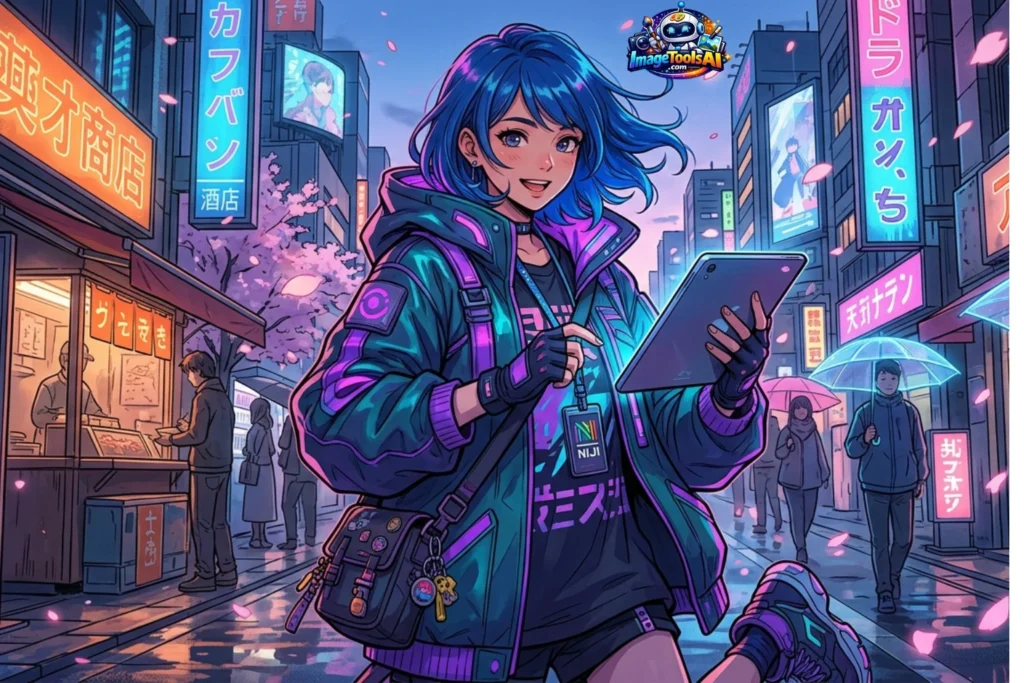
Built through a partnership between Midjourney and Spellbrush, Niji 5 focuses on one core strength: creating anime and manga visuals with strong character design, storytelling scenes, and polished style consistency.
Many users still ask:
- Is Niji 5 still relevant in 2026?
- Can newer models replace it?
- Is it good enough for professional anime content?
The answer depends on your goals. While newer tools like Leonardo AI, SDXL, and Midjourney V7 offer broader capabilities, Niji 5 still performs strongly for dedicated anime artwork.
This guide covers Niji 5’s features, prompts, pricing, use cases, comparisons, and optimization tips.
What is Niji 5?
Niji 5 from an NLP viewpoint
A single idea shapes each picture here – meaning pulled straight from words meant for anime minds. Words build scenes not by accident but design, feeding a system tuned to cartoon logic. Instead of guessing, the model connects phrases to frames with sharp attention. Picture creation leans hard on how things are described, not just what’s named. Language guides layout, color, motion – all shaped around clear phrasing. Each output answers a prompt like a sketch made from syntax. Style stays locked to animation roots while understanding complex descriptions. Structure matters more than flair when turning sentences into visuals.
A picture comes alive when words meet code – Niji 5 takes plain text, feeds it through smart algorithms shaped by countless anime drawings. Instead of just reading a description, you see it reimagined in vibrant cartoon form. Learning happens by studying thousands of hand-drawn scenes, letting the system grasp how characters look, move, and feel. It doesn’t invent from nothing – it reshapes language into frames inspired by what it has seen before. Each output mirrors styles found across Japanese animation history.
Main Focus Areas of Niji 5
Niji 5 is not a general-purpose image generator. It is specifically optimized for:
- Anime character generation
- Manga-style illustration design
- Fantasy storytelling environments
- Japanese-inspired visual aesthetics
- Cinematic anime scenes with emotional depth
This specialization gives it an advantage in stylistic consistency compared to general AI systems.
Why Niji 5 Became Popular
The popularity of Niji 5 is driven by its ability to interpret prompts with anime-specific semantic awareness.
Key advantages include:
- High-quality character consistency across multiple generations
- Strong emotional expression modeling (facial and pose-based cues)
- Improved understanding of anime terminology in prompts
- Ability to generate cinematic framing similar to manga panels
- Reduced need for manual post-processing
For creators, it acts as a prompt-driven illustration engine rather than a simple image generator.
How Niji 5 Works (Step-by-Step NLP + Diffusion Pipeline)
Niji 5 uses a combination of NLP encoding and diffusion-based image synthesis.
Step 1: Prompt Input
User inputs a structured prompt such as:
“anime samurai girl, glowing sword, sunset battlefield, cinematic lighting”
This sentence is tokenized into semantic units:
- Subject: samurai girl
- Object: sword
- Environment: battlefield
- Lighting: sunset
- Style: anime cinematic
Step 2: NLP Semantic Embedding
The system converts tokens into numerical vectors using transformer-based encoding.
This process captures:
- Meaning
- Context
- Relationships
- Emotional tone
- Artistic intent
Step 3: Diffusion Initialization
A random noise image is generated as a starting latent space.
Step 4: Iterative Refinement
The model gradually removes noise while aligning output with prompt embeddings.
This is where:
- Facial structures form
- Background details appear
- Lighting effects stabilize
- Color harmony is applied
Step 5: Output Generation
Multiple variations are generated, typically 4 outputs per prompt, allowing user selection.
Key Features of Niji 5
1. Anime-Centric Generative Architecture
Niji 5 is trained specifically on anime datasets, enabling:
- Stylized line art precision
- Proportional character modeling
- High saturation color control
- Manga-inspired composition
2. Emotion-Aware Character Synthesis
The model detects emotional signals in text, such as:
- Happiness
- Sadness
- Anger
- Fear
- Romance
And translates them into facial expressions and poses.
3. Cinematic Scene Generation
Niji 5 can interpret cinematic descriptors like:
- Wide-angle composition
- Depth of field
- Lighting gradients
- Atmospheric effects
4. Advanced Prompt Understanding
It supports complex NLP constructs such as:
- Multi-object relationships
- Hierarchical scene descriptions
- Conditional attributes
- Style blending
5. Style Variability System
Niji 5 allows controlled style modulation:
- Cute / Chibi style
- Dark fantasy
- Cinematic anime
- Monochrome manga
Niji 5 Prompt Engineering
Prompt engineering is the most critical factor in achieving high-quality outputs.
Optimal Prompt Structure
A high-performing prompt follows this NLP pattern:
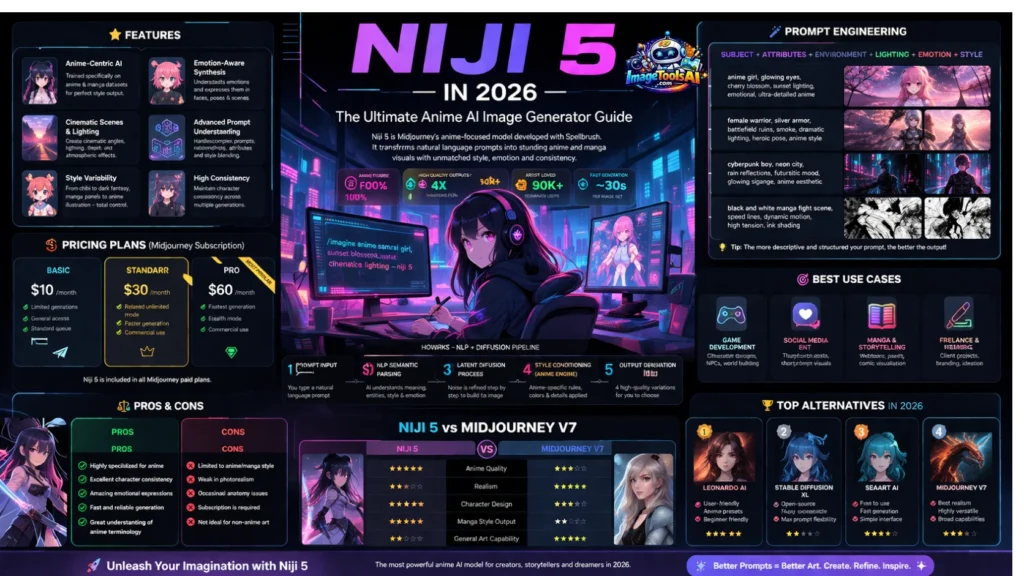
Subject + Attributes + Environment + Lighting + Emotion + Style Tags
Example 1: Character Prompt
anime girl, glowing eyes, cherry blossom environment, sunset lighting, emotional expression, ultra-detailed cinematic anime style
Example 2: Fantasy Warrior Prompt
female warrior, silver armor, battlefield ruins, smoke atmosphere, dramatic lighting, heroic pose, anime illustration style
Example 3: Cyberpunk Prompt
cyberpunk boy, neon city background, rain reflections, futuristic mood, glowing signage, anime aesthetic
Example 4: Manga Panel Prompt
black and white manga fight scene, speed lines, dynamic motion, high tension composition, ink shading style
How to Use Niji 5
Niji 5 operates within the Midjourney ecosystem.
Step 1: Access Platform
Join the Midjourney Discord server.
Step 2: Select Channel
Navigate to an image generation channel.
Step 3: Enter Prompt Command
/imagine anime knight in snow forest –niji 5
Step 4: Generate Output
AI produces 4 image variations.
Step 5: Refine and Upscale
Select the preferred version and upscale for higher resolution.
Pricing of Niji 5
Niji 5 is included within Midjourney subscription tiers:
| Plan | Price | Features |
| Basic | $10/month | Limited generations |
| Standard | $30/month | Relaxed unlimited mode |
| Pro | $60/month | Fast generation + commercial usage |
Pricing may vary based on platform updates.
Pros and Cons of Niji 5
Advantages
- Highly specialized anime generation engine
- Strong character consistency
- Excellent emotional expression rendering
- Fast image generation cycle
- Reliable stylistic control
Limitations
- Weak realism rendering
- Limited usage outside the anime domain
- Occasional anatomical inconsistencies
- Requires subscription-based access
Best Alternatives to Niji 5 in 2026
1. Leonardo AI
- User-friendly interface
- Strong anime preset library
- Beginner-friendly workflow
2. Stable Diffusion
Fully open-source ecosystem
- Maximum customization control
- Advanced prompt flexibility
3. SeaArt AI
- Free anime generation platform
- Simple UI and fast results
4. Midjourney V7
- Superior Realism Capabilities
- Less anime-focused but more versatile
Niji 5 vs Midjourney V7
| Feature | Niji 5 | Midjourney V7 |
| Anime Quality | High | Medium |
| Realism | Medium | Very High |
| Character Design | Excellent | Strong |
| Manga Style Output | Excellent | Limited |
| General Art Capability | Low | High |
Tips to Improve Niji 5 Output Quality
1. Use Descriptive NLP Prompts
Instead of simple prompts, use structured semantic detail.
2. Include Emotional Markers
Add words like:
- joyful
- mysterious
- intense
- calm
3. Add Lighting Context
Examples:
- neon glow
- sunset lighting
- soft cinematic light
4. Use Style Tokens
- anime illustration
- manga style
- cinematic anime
FAQs
A: Yes, it remains one of the strongest anime-focused AI generators for character and manga-style artwork.
A: Yes. However, better prompt engineering significantly improves results.
A: No, it is available only through Midjourney subscription plans.
A: It is specifically optimized for anime and manga-style visual generation rather than general image creation.
A: Yes, it is widely used for generating manga-style panels and sequential storytelling visuals.
Conclusion
By 2026, Niji 5 will still lead the way in creating anime through artificial intelligence. Even though more advanced tools have arrived offering wider functions, it’s this system that stays ahead when crafting visuals styled like Japanese animation. Yet its strength lies not in size but in precision – focusing only on what it does best.
Its power shows up when you look at how it handles language and creates new content
- Domain-specific training
- Strong semantic prompt understanding
- Consistent anime aesthetics
- High-quality character rendering
Still, when tackling wider creative tasks in 2026, Pairing Niji 5 with tools like Stable Diffusion or Leonardo AI tends to work best. Yet the strongest outcomes emerge this way.
Still, when tackling wider creative tasks in 2026, pairing Niji 5 with tools like Stable Diffusion or Leonardo AI tends to work best. Yet the strongest outcomes emerge this way.
Running low on Humanizer words. Your current Surfer package doesn’t cover more. Moving up plans opens extra access.